C++: STL编程
- TAGS: C++
STL概念
线性表
顺序表
vector
vector 基础概念
#include <iostream>
#include <vector>

using namespace std;

int main() {
    int a[6] = { 9, 8, 7, 6, 5, 4 };
    vector<int> v = { 2, 0, 2, 4 };
    cout << v.capacity() << endl; // 4 容量
    v.push_back(7);
    cout << v.capacity() << endl; // 5

    // 暂时把迭代器当前指针,实际上是类,它和指针差不多
    // front()                        back()
    // 2       0      2       4       7
    // ↑begin()                            ↑end()

    cout << "begin: -> " << *v.begin() << endl;     // 2
    cout << "end-1: -> " << *(v.end() - 1) << endl; // 7  因为end()位置是没有值的,会报错。这里取end前一个位置的值
    cout << "front: " << v.front() << endl;         // 2
    cout << "back: " << v.back() << endl;           // 7

    return 0;
}
vector 对象创建
#include <iostream>
#include <vector>
using namespace std;

void printVector(vector<int>& v) { // 使用引用就不会拷贝,const 不能改里面的值
    // 定义vector<int>的迭代器类型,从begin开始,到end结尾
    for (vector<int>::iterator iter = v.begin(); iter != v.end(); iter++ ) {
        cout << *iter << " ";
    }
    cout << endl;
}
int main() {
    // 1. 默认构造函数
    vector<int> v1;  // 创建后,v1中是没有内容的
    cout << "v1:";
    printVector(v1); // 无显示,因为没数据

    // 2. 初始化列表方式构造
    // int a[5] = {9, 8, 7, 6, 5};
    vector<int> v2_1 = { 9, 8, 7, 6, 5 }; // 隐式构造
    cout << "v2_1:";
    printVector(v2_1);
    vector<int> v2_2({ 9, 8, 7, 8, 5 });  // 有参构造
    cout << "v2_2:";
    printVector(v2_2);

    // 3. 迭代器方式
    vector<int> v3(v2_1.begin(), v2_1.end()); // 把v2_1的第1个元素到倒数第1个元素按顺序拷贝到v3上了。拷贝是左闭右开的
    cout << "v3:";
    printVector(v3);

    // 4. 全0初始化
    vector<int> v4(8); // 预申请8个内存空间,每个元素的值为0
    cout << "v4:";
    printVector(v4);

    // 5. vector<int> 变量名(a, b); 申请a个空间的元素,每个元素的值初始化为b
    vector<int> v5(8, 6);
    cout << "v5:";
    printVector(v5);

    // 6. 拷贝构造函数
    vector<int> v6(v2_2);
    cout << "v6:";
    printVector(v6);

    return 0;
}
vector 赋值操作
#include <iostream>
#include <vector>
using namespace std;

void printVector(vector<int>& v) {
    for (vector<int>::iterator iter = v.begin(); iter != v.end(); iter++) {
        cout << *iter << " ";
    }
    cout << endl;
}
int main() {
    vector<int> v = { 9, 8, 5, 2, 1, 1 };
    cout << "v:";
    printVector(v);

    // 1. = 赋值
    vector<int> v1 = v;
    cout << "v1:";
    printVector(v1);

    // 2. assign(迭代器)
    vector<int> v2;
    v2.assign(v1.begin(), v1.end());
    cout << "v2:";
    printVector(v2);

    // 3. 初始化列表
    vector<int> v3;
    v3.assign({ 1,2,3,4,5,6 });
    cout << "v3:";
    printVector(v3);

    // 4. 初始化a个b
    vector<int> v4;
    v4.assign(8, 6);
    cout << "v4:";
    printVector(v4); // v4:6 6 6 6 6 6 6 6

    return 0;
}
vector 数据插入
#include <iostream>
#include <vector>
using namespace std;

void printVector(vector<int>& v) {
    for (vector<int>::iterator iter = v.begin(); iter != v.end(); iter++) {
        cout << *iter << " ";
    }
    cout << endl;
}
/*
push_back(值)
insert(迭代器, 值)
*/
int main() {
    vector<int> v;
    for(int i = 0; i < 10; ++i) {
        v.push_back(i);
    }
    printVector(v);

    v.insert(v.begin(), 888); // 插在begin()的前面
    printVector(v);       // 888 0 1 2 3 4 5 6 7 8 9
    v.insert(v.begin()+1, 666); // 插在begin()的后面
    printVector(v);       // 888 666 0 1 2 3 4 5 6 7 8 9

    return 0;
}
vector 数据删除
#include <iostream>
#include <vector>
using namespace std;

void printVector(vector<int>& v) {
    for (vector<int>::iterator iter = v.begin(); iter != v.end(); iter++) {
        cout << *iter << " ";
    }
    cout << endl;
}
/*
1、pop_back  从后面删除
2、erase  指定位置删除,返回迭代器指向该位置的下一个位置
3、clear  所有全部删除
*/
int main() {
    vector<int> v = { 9,8,5,211 };
    printVector(v);  // 9 8 5 211

    // 1、pop_back
    v.pop_back();
    printVector(v);  // 9 8 5

    // 2、erase
    vector<int>::iterator it = v.erase(v.begin());  // 返回刚才删除的下一个位置
    printVector(v);  // 8 5
    cout << *it << endl; // 8

    // 3、clear
    v.clear();
    printVector(v);

    return 0;
}
vector 扩容机制
#include <iostream>
#include <vector>
using namespace std;

void printVector(vector<int>& v) {
    for (vector<int>::iterator iter = v.begin(); iter != v.end(); iter++) {
        cout << *iter << " ";
    }
    cout << endl;
}
/*
vector有容量和大小, 容量>=大小
容量:capacity()
大小:size()

resize   修改的是 size。不改变已有元素。
*/
int main() {
    vector<int> v1 = { 9,8,7,6 };
    printVector(v1);

    cout << "v1.size() = " << v1.size() << endl;             // 4
    cout << "v1.capacity() = " << v1.capacity() << endl;     // 4

    v1.push_back(3);
    cout << "v1.size() = " << v1.size() << endl;             // 5
    cout << "v1.capacity() = " << v1.capacity() << endl;     // 6 变成了原来的1.5倍。根据操作系统不同,可能扩容系数不同

    v1.push_back(1);
    v1.push_back(2);
    // 9 * 1.5 = 13.5 -> 14
    for (int i = 0; i < 3; ++i) {
        v1.push_back(i);
    }

    cout << "v1.size() = " << v1.size() << endl;             // 10
    cout << "v1.capacity() = " << v1.capacity() << endl;     // 13 向下取整

    v1.resize(18); // 改变size大小
    cout << "v1.size() = " << v1.size() << endl;             // 18
    cout << "v1.capacity() = " << v1.capacity() << endl;     // 19  = 13+13/2 向下取整
    printVector(v1);  // 9 8 7 6 3 1 2 0 1 2 0 0 0 0 0 0 0 0

    v1.resize(20, 6);
    cout << "v1.size() = " << v1.size() << endl;             // 20
    cout << "v1.capacity() = " << v1.capacity() << endl;     // 19 + 19/2 = 28 向下取整
    printVector(v1);  // 新加的2个元素初始化为6: 9 8 7 6 3 1 2 0 1 2 0 0 0 0 0 0 0 0 6 6

    v1.resize(100);
    cout << "v1.size() = " << v1.size() << endl;             // 100
    cout << "v1.capacity() = " << v1.capacity() << endl;     // 100。看源码,100 > 20 + 20/2 = 30,所以直接扩容到100
    printVector(v1);
/*
push_back函数源码分析
private:
    _CONSTEXPR20 size_type _Calculate_growth(const size_type _Newsize) const {
        // given _Oldcapacity and _Newsize, calculate geometric growth
        const size_type _Oldcapacity = capacity();
        const auto _Max              = max_size();

        if (_Oldcapacity > _Max - _Oldcapacity / 2) {
            return _Max; // geometric growth would overflow
        }

        const size_type _Geometric = _Oldcapacity + _Oldcapacity / 2;

        if (_Geometric < _Newsize) {
            return _Newsize; // geometric growth would be insufficient
        }

        return _Geometric; // geometric growth is sufficient
    }
*/

    v1.resize(5); // 改变size大小
    cout << "v1.size() = " << v1.size() << endl;             // 5
    cout << "v1.capacity() = " << v1.capacity() << endl;     // 100。
    printVector(v1);  // 9 8 7 6 3

    return 0;
}
vector 随机访问
#include <iostream>
#include <vector>
using namespace std;

void printVector(vector<int>& v) {
    for (vector<int>::iterator iter = v.begin(); iter != v.end(); iter++) {
        cout << *iter << " ";
    }
    cout << endl;
}

int main() {
    vector<int> v = { 9, 8, 7, 6 ,5 };
    cout << v[2] << endl;    // 7 和数组下标访问一样 用中括号访问效率更高些,见源码。
    cout << v.at(2) << endl; // 7 和数组下标访问一样

    //cout << v[12] << endl;    // 未定义行为
    //cout << v.at(12) << endl; // 抛出异常

    cout << "front: " << v.front() << endl;  // 9 5访问第一个元素
    cout << "back: " << v.back() << endl;    // 访问最后一个元素

    return 0;
}
vector 内存交换
#include <iostream>
#include <vector>
using namespace std;

void printVector(vector<int>& v) {
    for (vector<int>::iterator iter = v.begin(); iter != v.end(); iter++) {
        cout << *iter << " ";
    }
    cout << endl;
}

int main() {
    // 1. 内存交换
    vector<int> v1 = { 1, 2, 3, 4, 5 };
    vector<int> v2 = { 9, 8 , 7, 6, 5};
    cout << "v1: ";
    printVector(v1);   // v1: 1 2 3 4 5
    cout << "v2: ";
    printVector(v2);   // v2: 9 8 7 6 5

    v1.swap(v2);       // 交换v1和v2的内存
    cout << "v1: ";
    printVector(v1);   // v1: 9 8 7 6 5
    cout << "v2: ";
    printVector(v2);   // v2: 1 2 3 4 5

    // 2. 缩容
    v1.resize(10000);
    v1.resize(5);  // 重新调整v1的大小为5
    cout << "v1.capacity: " << v1.capacity() << endl;  // 10000
    vector<int>(v1).swap(v1);  // 匿名拷贝构造 vector<>int ()
    cout << "v1.capacity: " << v1.capacity() << endl;  // 5
    cout << "v1.capacity: " << v1.capacity() << endl;  // 5
    vector<int> x(v1);         // 调用拷贝构造函数
    cout << "x.capacity = " << x.capacity() << endl;   // 5

    // 3. 内存清理
    v2.reserve(100000);
    v2.clear();                // 不会清理内存空间,只是会把其size减小
    cout << "v2.capacity: " << v2.capacity() << endl;  // 100000
    vector<int>({}).swap(v2);  // 清理内存
    cout << "v2.capacity: " << v2.capacity() << endl;  // 0


    return 0;
}
vector 空间预留
#include <iostream>
#include <vector>
using namespace std;

int main() {
    vector<int> v;
    v.reserve(100);  // 预留100个空间
    for (int i = 0; i < 100; ++i) {
        cout << "size = " << v.size() << ", " << "capacity = " << v.capacity() << endl;
        v.push_back(i);
     }

    // reserve  修改的是 capacity
    // resize   修改的是 size
    return 0;
}
vector 高效删除
#include <iostream>
#include <vector>
using namespace std;

void remove1(vector<int>& v, int index) {
    v.erase(v.begin() + index);  // 内部进行大量的内存移动
}
void remove2(vector<int>& v, int index) {
    swap(v[index], v.back());    // 与最一个元素交换  O(1)
    v.pop_back();                // 删除最后一个元素  O(1)
}

void printVector(vector<int>& v) {
    for (int i = 0; i < v.size(); ++i) {
        cout << v[i] << ' ';
    }
    cout << endl;
}
int main() {
    // vector的物理结构是数组,所以中间某个元素被删除时,必需让后面的内存向前移动,这个效率就比较低了。
    vector<int> v;
    cout << "remove1: ";
    for (int i = 0; i < 150006; ++i) {
        v.push_back(i);
    }
    for (int i = 0; i < 150000; ++i) {
        remove1(v, 4);
    }
    cout << "结束" << endl;

    // 高效删除
    cout << "remove2: ";
    for (int i = 0; i < 200006; ++i) {
        v.push_back(i);
    }
    for (int i = 0; i < 200000; ++i) {
        remove2(v, 4);   // 前提,是对顺序要求不高的场景高效删除
    }
    //printVector(v);
    cout << "结束" << endl;

    return 0;
}
vector 数据排序
#include <iostream>
#include <algorithm>
#include <vector>
using namespace std;

void printVector(vector<int>& v) {
    for (int i = 0; i < v.size(); ++i) {
        cout << v[i] << ' ';
    }
    cout << endl;
}

bool cmp(int a, int b) {
    return a > b; // 如果a > b就是逆序排列,如果a < b就是顺序排列
}

int main() {
    // vector数据实际上是一个数组,我们可以用sort接口来排序,需要引用头文件algorithm, 算法
    vector<int> v = { 9, 8 , 7, 1, 2, 3, 4 };
    //sort(v.begin(), v.end()); // sort传入的是左半右开的迭代器
    sort(v.begin(), v.end(), cmp); // 实现cmp做递减排序
    printVector(v);
/*
sort源码分析
_CONSTEXPR20 void sort(const _RanIt _First, const _RanIt _Last, _Pr _Pred) { // order [_First, _Last)
     略
    _STD _Sort_unchecked(_UFirst, _ULast, _ULast - _UFirst, _STD _Pass_fn(_Pred));
}
_CONSTEXPR20 void _Sort_unchecked(_RanIt _First, _RanIt _Last, _Iter_diff_t<_RanIt> _Ideal, _Pr _Pred) {
    // order [_First, _Last)
    for (;;) {                                         // 迭代的死循环。不断地切分数组
        if (_Last - _First <= _ISORT_MAX) { // small   // 数组元素个数 <=32 时,使用插入排序。时间复杂度O(n^2)
            _STD _Insertion_sort_unchecked(_First, _Last, _Pred);
            return;
        }
        // divide and conquer by quicksort             // 大于32时,使用快排
        auto _Mid = _STD _Partition_by_median_guess_unchecked(_First, _Last, _Pred);
*/
}
练习
- 基于排列构建数组
https://leetcode.cn/problems/build-array-from-permutation/description/
给你一个 从 0 开始的排列 nums(下标也从 0 开始)。请你构建一个 同样长度 的数组 ans ,
其中,对于每个 i(0 <= i < nums.length),都满足 ans[i] = nums[nums[i]] 。返回构建好的数组 ans 。

从 0 开始的排列 nums 是一个由 0 到 nums.length - 1(0 和 nums.length - 1 也包含在内)的不同整数组成的数组。

示例 1:
输入:nums = [0,2,1,5,3,4]
输出:[0,1,2,4,5,3]
解释:数组 ans 构建如下:
ans = [nums[nums[0]], nums[nums[1]], nums[nums[2]], nums[nums[3]], nums[nums[4]], nums[nums[5]]]
    = [nums[0], nums[2], nums[1], nums[5], nums[3], nums[4]]
    = [0,1,2,4,5,3]

示例 2:
输入:nums = [5,0,1,2,3,4]
输出:[4,5,0,1,2,3]
解释:数组 ans 构建如下:
ans = [nums[nums[0]], nums[nums[1]], nums[nums[2]], nums[nums[3]], nums[nums[4]], nums[nums[5]]]
    = [nums[5], nums[0], nums[1], nums[2], nums[3], nums[4]]
    = [4,5,0,1,2,3]

提示:
1 <= nums.length <= 1000
0 <= nums[i] < nums.length
nums 中的元素 互不相同

进阶:你能在不使用额外空间的情况下解决此问题吗(即 O(1) 内存)?
class Solution { public: vector<int> buildArray(vector<int>& nums) { // 考查vector的插入操作 int n = nums.size(); vector<int> ans(n); for (int i = 0; i < nums.size(); ++i) { ans[i] = nums[nums[i]]; } return ans; } };
- 数组串联
https://leetcode.cn/problems/concatenation-of-array/
给你一个长度为 n 的整数数组 nums 。请你构建一个长度为 2n 的答案数组 ans ,
数组下标 从 0 开始计数 ,对于所有 0 <= i < n 的 i ,满足下述所有要求:

ans[i] == nums[i]
ans[i + n] == nums[i]
具体而言,ans 由两个 nums 数组 串联 形成。

返回数组 ans 。


示例 1:
输入:nums = [1,2,1]
输出:[1,2,1,1,2,1]
解释:数组 ans 按下述方式形成:
- ans = [nums[0],nums[1],nums[2],nums[0],nums[1],nums[2]]
- ans = [1,2,1,1,2,1]

示例 2:
输入:nums = [1,3,2,1]
输出:[1,3,2,1,1,3,2,1]
解释:数组 ans 按下述方式形成:
- ans = [nums[0],nums[1],nums[2],nums[3],nums[0],nums[1],nums[2],nums[3]]
- ans = [1,3,2,1,1,3,2,1]


提示:
n == nums.length
1 <= n <= 1000
1 <= nums[i] <= 1000
class Solution {
public:
    vector<int> getConcatenation(vector<int>& nums) {

        int n = nums.size();
        vector<int> ans(nums);  // 利用初始化时拷贝构造函数
        ans.resize(2*n);        // 扩容,前面元素不变,后面值为0
        for (int i = 0; i < n; ++i ) {
            ans[i+n] = nums[i];
        }
        return ans;
    }
};
string
string 基础概念
#include <iostream>
// #include <string> // 已经被包含在 <iostream> 中
using namespace std;

int main() {
    // C语言中的字符串是以\0结尾的字符数组
    char a[100] = "你好世界! Hello, World!";
    cout << a << endl;
    cout << (void*)a << endl; // 转化成 void* 类型输出地址

    // C++中的字符串是以string类来表示的,内部封装了char数组
    string b = "你好世界! Hello, World!";
    cout << b << endl;

    // a 和 b 的区别
    // a 是字符数组,b 是 string 类对象.
    cout << "sizeof(a): " << sizeof(a) << endl; // 数组大小  100
    cout << "sizeof(b): " << sizeof(b) << endl; // 类对象大小 40
    cout << "length of a: " << strlen(a) << endl; // 字符串长度 24
    cout << "length of b: " << b.length() << endl; // 字符串长度 24

    // 在C中所有对字符串的操作都是通过字符数组来完成的,C++中可以直接使用 string 类通过成员函数来操作字符串
    // 有了 string 类,C++程序员就不需要再去操心字符串的内存分配和释放问题了

    return 0;
}
string 对象创建
#include <iostream>
// #include <string> // 已经被包含在 <iostream> 中
using namespace std;

int main() {
    // 1. 无参构造
    string s1;  // 默认构造,s1 为空字符串
    cout << s1 << endl;

    // 2. 初始化列表构造
    string s2({ 'H', 'e', 'l', 'l', 'o' });
    cout << s2 << endl; // 输出 "Hello"

    // 3. 字符串初始化
    string s3("你好,世界!");
    cout << s3 << endl; // 输出 "你好,世界!"

    // 4. 字符串的前n个字符初始化
    string s4("你好,世界!", 6);  // 取前6个字符, 一个中文字符点2个字节,跟编码有关
    cout << s4 << endl; // 输出 "你好,"
    cout << s4.size() << endl; // 输出 6
    cout << (int)s4[4] << endl; // -93 中文字符是由多个ASCII码组成的,并且第一个字节是负数

    // 5. 拷贝构造
    string s5(s4);
    cout << s5 << endl; // 输出 "你好,"

    // 6. a 个 字符 b
    string s6(5, 'A'); // 初始化5个字符A. 注意:这里的 'A' 是单引号,表示字符
    cout << s6 << endl; // 输出 "AAAAA"

    return 0;
}
string 赋值操作
#include <iostream>
// #include <string> // 已经被包含在 <iostream> 中
using namespace std;

int main() {
    // 1. 字符串常量的赋值
    string s1;
    s1 = "你好,世界!";
    cout << s1 << endl;

    // 2. 字符串变量的赋值
    string s2;
    s2 = s1; // 将 s1 的值赋给 s2
    cout << s2 << endl;

    // 3. 字符常量赋值
    string s3;
    s3 = 'A'; // 将字符 'A' 赋值给字符串 s3
    cout << s3 << endl;

    // 4. assign() 方法赋值 v1
    string s4;
    s4.assign("你好,世界!");
    cout << s4 << endl;

    // 5. assign() 方法赋值 v2
    string s5;
    s5.assign("你好,世界!", 6); // 只赋值前 6 个字符
    cout << s5 << endl;

    // 6. assign() 方法赋值 v3
    string s6;
    s6.assign(s5); // 将 s5 的值赋给 s6
    cout << s6 << endl;

    // 7. a个b
    string s7;
    s7.assign(8, '6'); // 将字符 '6' 重复 8 次赋值给 s7
    cout << s7 << endl;

    return 0;
}
string 拼接操作
#include <iostream>
// #include <string> // 已经被包含在 <iostream> 中
using namespace std;

// C语言字符串拼接使用 strcat 函数,C++中可以使用 string 类的 + 运算符进行字符串拼接。

int main() {
    // 1. +
    string s1 = "你好";
    string t1 = "世界";
    s1 = s1 + ",";      // 加字符串 const char*
    s1 = s1 + t1;        // const string&
    //cout << s1 << endl;
    s1 = s1 + ';';        // 加字符 char
    cout << s1 << endl;

    // 2. +=
    string s2 = "世界";
    string t2 = "好啊";
    s2 += ",";      // 加字符串 const char*
    s2 += t2;        // const string&
    //cout << s2 << endl;
    s2 += ';';        // 加字符 char
    cout << s2 << endl;

    // 3. append
    string s3 = "大家";
    string t3 = "好";
    s3.append("都");
    s3.append(t3);
    s3.append("5201314", 3);    // 字符串取3个
    //cout << s3 << endl;       // 大家都好520
    s3.append("5201314", 3, 4); // 从第三个位置开始取4个元素
    cout << s3 << endl;         // 大家都好5201314

    // 4. push_back
    string s4 = "你好";
    s4.push_back('6');           // 只能向后添加字符
    s4.push_back('6');
    s4.push_back('6');
    cout << s4 << endl;          // 你好666

    return 0;
}
string 比较操作
#include <iostream>
// #include <string> // 已经被包含在 <iostream> 中
using namespace std;

int main() {
    // 1. compare
    string s1 = "aab";

    string t11 = "aab";
    int r11 = s1.compare(t11);  // 比较的结果有3种小于等于大于, 即-1 0 1
    cout << s1 << " compare " << t11 << " -> " << r11 << endl; // aab compare aab -> 0

    string t12 = "aaa";
    int r12 = s1.compare(t12);
    cout << s1 << " compare " << t12 << " -> " << r12 << endl; // aab compare aaa -> 1   a与a 比较返回0 a 与a比较, b>a 返回 1

    string t13 = "aac";
    int r13 = s1.compare(t13);
    cout << s1 << " compare " << t13 << " -> " << r13 << endl; // aab compare aac -> -1

    string t14 = "aaba";
    int r14 = s1.compare(t14);
    cout << s1 << " compare " << t14 << " -> " << r14 << endl; // aab compare aaba -> -1 长度,短的减长的等于 -1

    string t15 = "aa";
    int r15 = s1.compare(t15);
    cout << s1 << " compare " << t15 << " -> " << r15 << endl; // aab compare aa -> 1 长度,长的减短的等于 1
/*
compare源码分析
    _NODISCARD _CONSTEXPR20 int compare(const basic_string& _Right) const noexcept {
        return _Traits_compare<_Traits>(_Mypair._Myval2._Myptr(), _Mypair._Myval2._Mysize,
            _Right._Mypair._Myval2._Myptr(), _Right._Mypair._Myval2._Mysize);
    }

constexpr int _Traits_compare(_In_reads_(_Left_size) const _Traits_ptr_t<_Traits> _Left, const size_t _Left_size,
    _In_reads_(_Right_size) const _Traits_ptr_t<_Traits> _Right, const size_t _Right_size) noexcept {
    // compare [_Left, _Left + _Left_size) to [_Right, _Right + _Right_size) using _Traits
    const int _Ans = _Traits::compare(_Left, _Right, (_STD min)(_Left_size, _Right_size));  // 取最小值 _STD min

    if (_Ans != 0) {
        return _Ans;
    }

    if (_Left_size < _Right_size) {  // 前面的长度小于后面的长度,返回-1
        return -1;
    }

    if (_Left_size > _Right_size) {  // 前面的长度大于后面的长度,返回1
        return 1;
    }

    return 0;
}
*/

    // 2. < > = <= >=
    cout << s1 << " == " << t11 << " -> " << (s1 == t11) << endl; // aab == aab -> 1 运算符的重载
    cout << s1 << " != " << t11 << " -> " << (s1 != t11) << endl; // aab != aab -> 0
    cout << s1 << " < " << t12 << " -> " << (s1 < t12) << endl;   // aab < aaa -> 0

    return 0;
}
string 随机访问
#include <iostream>
// #include <string> // 已经被包含在 <iostream> 中
using namespace std;

int main() {
    // 随机访问任意一个下标位置
    string s = "I love you 1314";
    // 1. 访问
    cout << s << endl;   // I love you 1314
    for(int i = 0; i < s.size(); ++i) {
        // s.size() 返回字符串的长度,不包括终止符 '\0'
        cout << s[i] << " ";
    }
    cout << endl;
    for (int i = 0; i < s.size(); ++i) {
        cout << s.at(i) << " ";
    }
    cout << endl;     // I   l o v e   y o u   1 3 1 4

    //s[100];

    // 2. 修改
    s[11] = '5';
    s[12] = '2';
    s.at(13) = '0';  // 返回的是引用,可以被修改
    s.at(14) = ' ';
    cout << s << endl;  // I love you 520

    return 0;
}
string 数据插入
#include <iostream>
// #include <string> // 已经被包含在 <iostream> 中
using namespace std;

int main() {
    string s1 = "Heworld";
    s1.insert(2, 2, 'l'); // 位置、个数、字符。 表示在2的位置前面插入2个l字符
    cout << s1 << endl;   // Hellworld
    s1.insert(4, "o");    // 在4的位置插入字符串o
    cout << s1 << endl;   // Helloworld

    s1.insert(s1.size(), "aaaa"); // 最后插入字符串
    cout << s1 << endl;   // Helloworldaaaa

    // 传迭代器,插入字符
    s1.insert(s1.begin(), ':');
    cout << s1 << endl;    // :Helloworldaaaa


    return 0;
}
string 数据删除
#include <iostream>
// #include <string> // 已经被包含在 <iostream> 中
using namespace std;

int main() {
    string s1;

    // 1
    s1 = "Hello woooorld";
    s1.erase();          // 全部删除
    cout << s1 << endl;  // 返回空串

    // 2
    s1 = "Hello woooorld";
    s1.erase(7);         // 删除从7位置开始到结尾的所有字符
    cout << s1 << endl;  // Hello w

    // 3
    s1 = "Hello woooorld";
    s1.erase(7, 3);      // 从7位置开始删除3个字符
    cout << s1 << endl;  // Hello world

    // 4
    s1 = "Hello woooorld";
    s1.erase(s1.begin()); // 传入迭代器,删除1个字符
    cout << s1 << endl;   // ello woooorld

    s1 = "Hello woooorld";
    s1.erase(s1.begin() + 7, s1.begin() + 10); // 删除左半右开区间中的字符。 [x, y)
    cout << s1 << endl;   // Hello world


    return 0;
}
string 数据查找
#include <iostream>
// #include <string> // 已经被包含在 <iostream> 中
using namespace std;

int main() {
    // 查找一个字符串是否在另一个字符串中是否存在,并返回下标索引
    string s1;

    // 1
    s1 = "Hello woooorld";
    cout << s1.find("oooo") << endl;  // 7

    // 2
    s1 = "Hello woooorld";
    cout << (int)s1.find("oooo", 8) << endl;  // 从8位置开始找,没找到返回值为 -1
    cout << (int)s1.find("oooo", 5) << endl;  // 7

    // 3
    cout << s1.find('o') << endl;             // 4
    cout << s1.find('o', s1.find('o')+1) << endl;  // 从第5个位置开始找字符o的位置,输出为7

    // 4
    cout << s1.rfind("oo") << endl;          // 从右开始向左找,找到oo的位置,输出为 9

    return 0;
}
string 数据替换
#include <iostream>
// #include <string> // 已经被包含在 <iostream> 中
using namespace std;

int main() {
    string s;

    // 1
    s = "Hello woooorld";
    s.replace(7, 5, "or");   // 位置、个数、替换的字符串。 从7位置开始的5个元素oooor替换成or
    cout << s << endl;       // Hello world

    // 2
    s = "Hello woooorld";
    s.replace(s.begin() + 7, s.begin() + 12, "or"); // 传迭代器, [起始位置,终止位置)、替换的字符串
    cout << s << endl;       // Hello world

    // 3
    s = "Hello woooorld";
    s.replace(s.begin() + 7, s.begin() + 12, "orxxxxxxxxxxxxxxxxx", 2); // 传迭代器, [起始位置,终止位置)、替换的字符串前2个字符
    cout << s << endl;       // Hello world

    return 0;
}
string 子串获取
#include <iostream>
// #include <string> // 已经被包含在 <iostream> 中
using namespace std;

int main() {
    // 子串:给定一个字符串和一个下标以及要获取字符的数量,返回原字符串的子串
    string s1;
    s1 = "Hello woooorld";
    string subStr = s1.substr(7, 4);
    cout << subStr << endl;          // oooo

    // 应用
    string s2 = "你好&&世界";
    int pos = s2.find("&&");         // 拿到&&的位置
    string s3 = s2.substr(0, pos);
    string s4 = s2.substr(pos+2);    // 从pos+2位置开始到最后
    cout << s3 << ' ' << s4 << endl; // 你好 世界

    return 0;
}
练习
- 动态口令
https://leetcode.cn/problems/zuo-xuan-zhuan-zi-fu-chuan-lcof/
在学习章节提到过[[h:learn-module-up-packages][(精选 packages, 大大提升你的 Emacs 编辑效率)]]

某公司门禁密码使用动态口令技术。初始密码为字符串 password,密码更新均遵循以下步骤:

设定一个正整数目标值 target
将 password 前 target 个字符按原顺序移动至字符串末尾
请返回更新后的密码字符串。

示例 1:
输入: password = "s3cur1tyC0d3", target = 4
输出: "r1tyC0d3s3cu"

示例 2:
输入: password = "lrloseumgh", target = 6
输出: "umghlrlose"

提示:
1 <= target < password.length <= 10000
class Solution {
public:
    string dynamicPassword(string password, int target) {
        return password.substr(target)+password.substr(0, target);
    }
};
- 查找包含给定字符的单词
https://leetcode.cn/problems/find-words-containing-character/
给你一个下标从 0 开始的字符串数组 words 和一个字符 x 。

请你返回一个 下标数组 ,表示下标在数组中对应的单词包含字符 x 。

注意 ,返回的数组可以是 任意 顺序。

示例 1:
输入:words = ["leet","code"], x = "e"
输出:[0,1]
解释:"e" 在两个单词中都出现了:"leet" 和 "code" 。所以我们返回下标 0 和 1 。

示例 2:
输入:words = ["abc","bcd","aaaa","cbc"], x = "a"
输出:[0,2]
解释:"a" 在 "abc" 和 "aaaa" 中出现了,所以我们返回下标 0 和 2 。

示例 3:
输入:words = ["abc","bcd","aaaa","cbc"], x = "z"
输出:[]
解释:"z" 没有在任何单词中出现。所以我们返回空数组。

提示:
1 <= words.length <= 50
1 <= words[i].length <= 50
x 是一个小写英文字母。
words[i] 只包含小写英文字母。
class Solution {
public:
    vector<int> findWordsContaining(vector<string>& words, char x) {
        vector<int> ans;
        for(int i = 0; i < words.size(); ++i) {
            for(int j = 0; j < words[i].size(); ++j) {
                if(words[i][j] == x) {
                    ans.push_back(i);  // 只需插入一次
                    break;
                }
            }
        }
        return ans;
    }
};
分段顺序表
deque
deque 基础概念
双端队列,可以在头部和尾部插入。
- front() 头部元素
push_front()头部插入po_front()头部删除
- back() 尾部元素
push_back()尾部插入pop_back()尾部删除
- begin() 指向头部的迭代器
- end() 指向尾部的下一个元素迭代器
vector也支持,为什么要引入deque?
- 因为vector在头部插入元素时,会把后面的元素向后挪。当vector元素很多时,插入效率就非常低了。
deque核心是指针数组,数组中的元素是指针指向一块连续的内存。
#include <iostream>
#include <deque>
using namespace std;

int main() {
    deque<int> d;

    return 0;
}
deque 对象创建
#include <iostream>
#include <deque>
using namespace std;

void printDeque(deque<int>& d) {
    for (deque<int>::iterator iter = d.begin(); iter != d.end(); iter++) {
        cout << *iter << " ";
    }
    cout << endl;
}
int main() {
    // 1. 默认构造函数
    deque<int> d1;
    cout << "d1: ";
    printDeque(d1);    // d1:

    // 2. 初始化列表
    deque<int> d2_1({ 9, 8, 8, 6, 5 });
    cout << "d2_1: ";
    printDeque(d2_1);  // d2_1: 9 8 8 6 5
    deque<int> d2_2 = { 1, 8, 8, 6, 5 };
    cout << "d2_2: ";
    printDeque(d2_2);  // d2_2: 1 8 8 6 5

    // 3. 迭代器
    deque<int> d3(d2_1.begin()+1, d2_1.end()-1);
    cout << "d3: ";
    printDeque(d3);    // d3: 8 8 6

    // 4. 全0初始化
    deque<int> d4(10);
    cout << "d4: ";
    printDeque(d4);    // d4: 0 0 0 0 0 0 0 0 0 0

    // 5. deque<int> 变量名(a, b)  表示申请a个元素空间,每个元素的值初始化为b
    deque<int> d5(8, 6);
    cout << "d5: ";
    printDeque(d5);    // d5: 6 6 6 6 6 6 6 6

    // 6. 拷贝构造函数
    deque<int> d6(d5);
    cout << "d6: ";
    printDeque(d6);    // d6: 6 6 6 6 6 6 6 6

    return 0;
}
deque 赋值操作
#include <iostream>
#include <deque>
using namespace std;

void printDeque(deque<int>& d) {
    for (deque<int>::iterator iter = d.begin(); iter != d.end(); iter++) {
        cout << *iter << " ";
    }
    cout << endl;
}
int main() {
    deque<int> d = { 9,8,5,2,1,1 };
    cout << "d: ";
    printDeque(d);  // d: 9 8 5 2 1 1

    // 1. = 赋值
    deque<int> d1;
    d1 = d;
    cout << "d1: ";
    printDeque(d1); // d1: 9 8 5 2 1 1

    // 2. assign(迭代器)
    deque<int> d2;
    d2.assign(d1.begin() + 1, d1.end());
    cout << "d2: ";
    printDeque(d2); // d2: 8 5 2 1 1

    // 3. 初始化列表
    deque<int> d3;
    d3.assign({ 1,2,3,5,6,7 });
    cout << "d3: ";
    printDeque(d3); // d3: 1 2 3 5 6 7

    // 4. 初始化a个b
    deque<int> d4;
    d4.assign(8, 6); // 申请8个元素空间,元素值都为6
    cout << "d4: ";
    printDeque(d4);  // d4: 6 6 6 6 6 6 6 6

    return 0;
}
deque 大小操作
#include <iostream>
#include <deque>
using namespace std;

void printDeque(deque<int>& d) {
    /*for (deque<int>::iterator iter = d.begin(); iter != d.end(); iter++) {
        cout << *iter << " ";
    }*/
    for (int i = 0; i < d.size(); ++i) {
        cout << d[i] << " ";
    }
    cout << endl;
}

/*
1、empty  判断是否为空
2、size   获取元素个数
3、resize 设置元素个数
*/
int main() {
    deque<int> d;

    cout << "d.empty() = " << d.empty() << endl;  // 1
    cout << "d.size() = " << d.size() << endl;    // 0

    d.assign({ 1,2,3 });
    cout << "d.empty() = " << d.empty() << endl;  // 0
    cout << "d.size() = " << d.size() << endl;    // 3
    printDeque(d);  // 1 2 3

    d.resize(18);
    cout << "d.size() = " << d.size() << endl;    // 18
    printDeque(d);  // 1 2 3 0 0 0 0 0 0 0 0 0 0 0 0 0 0 0

    d.resize(20, 6); // 从18到20,对新增的2个元素初始化为6
    cout << "d.size() = " << d.size() << endl;    // 20
    printDeque(d);  // 1 2 3 0 0 0 0 0 0 0 0 0 0 0 0 0 0 0 6 6

    d.resize(10000);
    d.resize(5);
    cout << "d.size() = " << d.size() << endl;    // 5
    printDeque(d);  // 1 2 3 0 0

    return 0;
}
deque 数据插入
#include <iostream>
#include <deque>
using namespace std;

void printDeque(deque<int>& d) {
    /*for (deque<int>::iterator iter = d.begin(); iter != d.end(); iter++) {
        cout << *iter << " ";
    }*/
    for (int i = 0; i < d.size(); ++i) {
        cout << d[i] << " ";
    }
    cout << endl;
}

/*
1、push_front 头插
2、push_back  尾插
3、insert     中间插
*/
int main() {
    deque<int> d;

    // 1、push_front 头插
    d.push_front(-1);
    d.push_front(-2);
    d.push_front(-3);
    printDeque(d); // -3 -2 -1

    // 2、push_back  尾插
    d.push_back(1);
    d.push_back(2);
    d.push_back(3);
    printDeque(d); // -3 -2 -1 1 2 3

    // 3、insert     中间插
    d.insert(d.begin() + 3, 0); // 在3的位置插入0
    d.insert(d.end() - 1, 5, 8); // 在最后前面的位置插入5个8
    printDeque(d); // -3 -2 -1 0 1 2 8 8 8 8 8 3

    d.insert(d.begin() + 1, d.begin() + 4, d.begin() + 6); // 在1的位置插入从4位置到6位置的值, 左闭右开 [4, 6)。
    printDeque(d); // -3 1 2 -2 -1 0 1 2 8 8 8 8 8 3

    return 0;
}
deque 数据删除
#include <iostream>
#include <deque>
using namespace std;

void printDeque(deque<int>& d) {
    /*for (deque<int>::iterator iter = d.begin(); iter != d.end(); iter++) {
        cout << *iter << " ";
    }*/
    for (int i = 0; i < d.size(); ++i) {
        cout << d[i] << " ";
    }
    cout << endl;
}

/*
1、pop_front 头删
2、pop_back  尾删
3、erase、clear
*/
int main() {
    deque<int> d = { -1, 9, 8, 5, 2, 1, 1, -1 };
    printDeque(d);  // -1 9 8 5 2 1 1 -1

    // 1、pop_front 头删
    d.pop_front();
    printDeque(d); // 9 8 5 2 1 1 -1

    // 2、pop_back  尾删
    d.pop_back();
    printDeque(d); // 9 8 5 2 1 1

    // 3、erase、clear
    // 删除1个元素
    deque<int>::iterator it = d.erase(d.begin() + 2);  // 删除位置2的值,返回下一个位置
    printDeque(d);  // 9 8 2 1 1
    cout << *it << endl;  // 2
    it = d.erase(it);
    printDeque(d);  // 9 8 1 1
    cout << *it << endl; // 1
    // 删除多个元素
    d.erase(d.begin() + 1, d.begin() + 3); // 从位置1删除2个元素
    printDeque(d); // 9 1

    // 删除所有
    d.clear();

    cout << "d.empty() = " << d.empty() << endl;  // 1
    cout << "d.size() = " << d.size() << endl;    // 0

    return 0;
}
deque 扩容机制
deque物理结构是一个指针数组。
源码中
_Map = 0x0000000指针数组的首地址_Mysize = 0元素大小_Myoff = 0每次往前插入off减1。向后插这个值不更新Mapsize = 0指针数组的长度_Ty = long long类型_Block_size = 2根据类型更新对应的值
#include <iostream>
#include <deque>
using namespace std;

int main() {
    deque<long long> d;

    for (int i = 0; i < 9; ++i) {
        d.push_back(i);
    }
    for (int i = 9; i < 18; ++i) {
        d.push_front(i);
    }
    return 0;
}
打断点调试。
deque 随机访问
#include <iostream>
#include <deque>
using namespace std;

int main() {
    // 随机访问可以理解为数组的下标访问
    deque<int> d = { 9, 8, 7, 6, 5 };

    cout << d[2] << endl;    // 7
    cout << d.at(3) << endl; // 6

    cout << d.front() << endl; // 9
    cout << d.back() << endl;  // 5

/* 源码分析
at():检查范围并返回指定位置的元素,如果索引超出范围则抛出异常。
operator[]:直接返回指定位置的元素,不进行范围检查。
    _NODISCARD reference operator[](size_type _Pos) noexcept {
#if _MSVC_STL_HARDENING_DEQUE || _ITERATOR_DEBUG_LEVEL != 0
        _STL_VERIFY(_Pos < _Mysize(), "deque subscript out of range");
#endif

        return _Subscript(_Pos);
    }
    _NODISCARD reference at(size_type _Pos) {
        if (_Mysize() <= _Pos) {
            _Xran();
        }

        return _Subscript(_Pos);
    }

        reference _Subscript(size_type _Pos) noexcept {
        return _Get_data()._Subscript(_Myoff() + _Pos);
    }

    class _Deque_val : public _Container_base12 {
public:
    _Map_difference_type _Getblock(size_type _Off) const noexcept {
        // NB: _Mapsize and _Block_size are guaranteed to be powers of 2
        return static_cast<_Map_difference_type>((_Off / _Block_size) & (_Mapsize - 1));
    }

    reference _Subscript(size_type _Off) noexcept {
        const auto _Block     = _Getblock(_Off);
        const auto _Block_off = static_cast<difference_type>(_Off % _Block_size);
        return _Map[_Block][_Block_off];
    }

    _Map[_Block][_Block_off]:
      _Map 是指针数组,
      _Block 位置_Off/_Block_size 得到块索引,
      再通过下标索引_Block_off拿到具体的值

*/
    return 0;
}
练习
- 设计循环双端队列
https://leetcode.cn/problems/design-circular-deque/
设计实现双端队列。

实现 MyCircularDeque 类:

MyCircularDeque(int k) :构造函数,双端队列最大为 k 。
boolean insertFront():将一个元素添加到双端队列头部。 如果操作成功返回 true ,否则返回 false 。
boolean insertLast() :将一个元素添加到双端队列尾部。如果操作成功返回 true ,否则返回 false 。
boolean deleteFront() :从双端队列头部删除一个元素。 如果操作成功返回 true ,否则返回 false 。
boolean deleteLast() :从双端队列尾部删除一个元素。如果操作成功返回 true ,否则返回 false 。
int getFront() ):从双端队列头部获得一个元素。如果双端队列为空,返回 -1 。
int getRear() :获得双端队列的最后一个元素。 如果双端队列为空,返回 -1 。
boolean isEmpty() :若双端队列为空,则返回 true ,否则返回 false  。
boolean isFull() :若双端队列满了,则返回 true ,否则返回 false 。


示例 1:

输入
["MyCircularDeque", "insertLast", "insertLast", "insertFront",
"insertFront", "getRear", "isFull", "deleteLast", "insertFront", "getFront"]
[[3], [1], [2], [3], [4], [], [], [], [4], []]
输出
[null, true, true, true, false, 2, true, true, true, 4]

解释
MyCircularDeque circularDeque = new MycircularDeque(3); // 设置容量大小为3
circularDeque.insertLast(1);                    // 返回 true
circularDeque.insertLast(2);                    // 返回 true
circularDeque.insertFront(3);                   // 返回 true
circularDeque.insertFront(4);                   // 已经满了,返回 false
circularDeque.getRear();                        // 返回 2
circularDeque.isFull();                         // 返回 true
circularDeque.deleteLast();                     // 返回 true
circularDeque.insertFront(4);                   // 返回 true
circularDeque.getFront();                       // 返回 4

提示:
1 <= k <= 1000
0 <= value <= 1000
insertFront, insertLast, deleteFront, deleteLast, getFront, getRear, isEmpty, isFull  调用次数不大于 2000 次
class MyCircularDeque {
    deque<int> d;
    int capacity; // 容量
    int size;     // 当前元素个数
public:
    MyCircularDeque(int k) {
        d.clear();
        capacity = k;
        size = 0;
    }

    bool insertFront(int value) {
        if (capacity == size) {  // 队列满了不能执行插入
            return false;
        }
        ++size;
        d.push_front(value);
        return true;
    }

    bool insertLast(int value) {
        if (capacity == size) {  // 队列满了不能执行插入
            return false;
        }
        ++size;
        d.push_back(value);
        return true;
    }

    bool deleteFront() {
        if (size == 0) {  // size为0时不能执行删除
            return false;
        }
        size--;
        d.pop_front();
        return true;
    }

    bool deleteLast() {
                if (size == 0) {  // size为0时不能执行删除
            return false;
        }
        size--;
        d.pop_back();
        return true;
    }

    int getFront() {
        if(size == 0) return -1;
        return d.front();
    }

    int getRear() {
        if(size == 0) return -1;
        return d.back();
    }

    bool isEmpty() {
        return size == 0;
    }

    bool isFull() {
        return size == capacity;
    }
};

/**
 * Your MyCircularDeque object will be instantiated and called as such:
 * MyCircularDeque* obj = new MyCircularDeque(k);
 * bool param_1 = obj->insertFront(value);
 * bool param_2 = obj->insertLast(value);
 * bool param_3 = obj->deleteFront();
 * bool param_4 = obj->deleteLast();
 * int param_5 = obj->getFront();
 * int param_6 = obj->getRear();
 * bool param_7 = obj->isEmpty();
 * bool param_8 = obj->isFull();
 */
- 设计浏览器历史记录
class BrowserHistory {
    deque<string> urls;
    int currIndex;
public:
    BrowserHistory(string homepage) {
        urls.push_back(homepage);
        currIndex = 0;
    }

    void visit(string url) {
        while(urls.size() > currIndex+1){
            urls.pop_back();
        }
        urls.push_back(url);
        currIndex++;
    }

    string back(int steps) {
        currIndex = max(currIndex - steps, 0);
        return urls[currIndex];
    }

    string forward(int steps) {
        currIndex = min(currIndex + steps, int(urls.size() - 1));
        return urls[currIndex];
    }
};

/**
 * Your BrowserHistory object will be instantiated and called as such:
 * BrowserHistory* obj = new BrowserHistory(homepage);
 * obj->visit(url);
 * string param_2 = obj->back(steps);
 * string param_3 = obj->forward(steps);
 */
链表
list
list 基础概念
底层结构是deque双端队列。
逻辑结构和vector是一样的
- front() 头部元素
push_front()头部插入po_front()头部删除
- back() 尾部元素
push_back()尾部插入pop_back()尾部删除
- begin() 指向头部的迭代器
- end() 指向尾部的下一个元素迭代器
物理结构
- 节点node
- val
- next 指向下一个node的指针
- prev 指向上一个node的指针
是个双向循环链表。
#include <iostream>
#include <list>
using namespace std;

int main() {
    list<int> l;

/*
class list { // bidirectional linked list
    _Compressed_pair<_Alnode, _Scary_val> _Mypair;
};

    using _Scary_val = _List_val<_Val_types>;

    class _List_val : public _Container_base {
public:
    _List_val() noexcept : _Myhead(), _Mysize(0) {} // initialize data
    ...};
    ...

        _Nodeptr _Myhead; // pointer to head node
    ...

    using _Nodeptr = typename _Val_types::_Nodeptr;
    ...

    using _Node    = _List_node<_Ty, void*>;
    using _Nodeptr = _Node*;
    ...

    struct _List_node { // list node
    using value_type = _Value_type;
    using _Nodeptr   = _Rebind_pointer_t<_Voidptr, _List_node>;
    _Nodeptr _Next; // successor node, or first element if head
    _Nodeptr _Prev; // predecessor node, or last element if head
    _Value_type _Myval = // the stored value, unused if head
*/

    return 0;
}
list 对象创建
#include <iostream>
#include <list>
using namespace std;

void printList(const list<int>& l) {
    for (list<int>::const_iterator it = l.begin(); it != l.end(); ++it) {
        cout << *it << " ";
    }
    cout << endl;
}

int main() {
    // 1. 默认构造函数
    list<int> l1;
    cout << "l1: ";
    printList(l1); // l1:

    // 2. 初始化列表
    list<int> l2_1 = {9,8,7,6,5};
    cout << "l2_1: ";
    printList(l2_1);  // l2_1: 9 8 7 6 5

    list<int> l2_2({ 9,8,7,1,5 });
    cout << "l2_2: ";
    printList(l2_2);  // l2_2: 9 8 7 1 5

    // 3. 迭代器
    list<int> l3(l2_1.begin(), l2_1.end()); // 把l2_1的元素复制到l3
    cout << "l3: ";
    printList(l3);    // l3: 9 8 7 6 5

    // 4. 全0初始化
    list<int> l4(8);
    cout << "l4: ";
    printList(l4);    // l4: 0 0 0 0 0 0 0 0

    // 5. list<int> 变量名(a, b) 表示申请a个空间的元素,每个元素初始化为b
    list<int> l5(8, 6);
    cout << "l5: ";
    printList(l5);    // l5: 6 6 6 6 6 6 6 6

    // 6. 拷贝构造函数
    list<int> l6(l2_2);
    cout << "l6: ";
    printList(l6);    // l6: 9 8 7 1 5

    return 0;
}
list 赋值操作
#include <iostream>
#include <list>
using namespace std;

void printList(const list<int>& l) {
    for (list<int>::const_iterator it = l.begin(); it != l.end(); ++it) {
        cout << *it << " ";
    }
    cout << endl;
}

int main() {
    list<int> l = { 9, 8, 5, 2, 1, 1 };
    cout << "l: ";
    printList(l);  // l: 9 8 5 2 1 1

    // 1. = 赋值
    list<int> l1;
    l1 = l;
    cout << "l1 ";
    printList(l1);  // l1: 9 8 5 2 1 1

    // 2. assign(迭代器区间)
    list<int> l2;
    l2.assign(l.begin(), l.end());
    cout << "l2: ";
    printList(l1);  // l2: 9 8 5 2 1 1

    // 3. assign(初始值列表)
    list<int> l3;
    l3.assign({ 1,3,1,4 });
    cout << "l3: ";
    printList(l3);  // l3: 1 3 1 4

    // 4. assign(元素个数a, 初始值b) 初始化a个b
    list<int> l4;
    l4.assign(8, 6);
    cout << "l4: ";
    printList(l4);  // l4: 6 6 6 6 6 6 6 6

    return 0;
}
list 大小操作
#include <iostream>
#include <list>
using namespace std;

void printList(const list<int>& l) {
    for (list<int>::const_iterator it = l.begin(); it != l.end(); ++it) {
        cout << *it << " ";
    }
    cout << endl;
}

/*
1、empty 判断列表是否为空
2、size 返回列表中元素的个数
3、resize 改变列表的大小 并把数据初始化为指定值
*/
int main() {
    list<int> l;
    cout << "l.empty() = " << l.empty() << endl; // 1
    cout << "l.size() = " << l.size() << endl;   // 0

    l.assign({ 1,2,3 });
    cout << "l.empty() = " << l.empty() << endl; // 0
    cout << "l.size() = " << l.size() << endl;   // 3

    l.resize(18);
    cout << "l.empty() = " << l.empty() << endl; // 0
    cout << "l.size() = " << l.size() << endl;   // 18
    printList(l); // 1 2 3 0 0 0 0 0 0 0 0 0 0 0 0 0 0 0

    l.resize(20, 6);
    cout << "l.empty() = " << l.empty() << endl; // 0
    cout << "l.size() = " << l.size() << endl;   // 20
    printList(l); // 1 2 3 0 0 0 0 0 0 0 0 0 0 0 0 0 0 0 6 6

    l.resize(10000);
    l.resize(5);
    cout << "l.empty() = " << l.empty() << endl; // 0
    cout << "l.size() = " << l.size() << endl;   // 5
    printList(l); // 1 2 3 0 0

    return 0;
}
list 数据插入
#include <iostream>
#include <list>
using namespace std;

void printList(const list<int>& l) {
    for (list<int>::const_iterator it = l.begin(); it != l.end(); ++it) {
        cout << *it << " ";
    }
    cout << endl;
}

/*
1、push_front 头插
2、push_back  尾插
3、insert     中间插
*/

int main() {
    list<int> l;

    // 1、push_front 头插
    l.push_front(-1); // -1
    l.push_front(-2); // -2 -1
    l.push_front(-3); // -3 -2 -1
    printList(l);     // -3 -2 -1

    // 2、push_back  尾插
    l.push_back(1);  // -3 -2 -1 1
    l.push_back(2);  // -3 -2 -1 1 2
    l.push_back(3);  // -3 -2 -1 1 2 3
    printList(l);    // -3 -2 -1 1 2 3

    // 3、insert     中间插
    // 3.1 insert(迭代器, 值)
    list<int>::iterator it = l.begin();
    it++;
    it++;
    it++;
    //it = it + 1; // 没有这样的运算,如果实现了会造成访问效率低下如 it = it + 7000000000
    l.insert(it, 0); // -3 -2 -1 0 1 2 3
    printList(l);    // -3 -2 -1 0 1 2 3

    // 3.1 insert(迭代器, 数量, 值)
    it = l.end();
    --it;
    l.insert(it, 5, 8);
    printList(l); // -3 -2 -1 0 1 2 8 8 8 8 8 3

    // 3.1 insert(迭代器, 迭代器的开始位置, 迭代器的结束位置)
    it = l.begin();
    it++;
    l.insert(it, l.begin(), l.end());
    printList(l);  // -3 -3 -2 -1 0 1 2 8 8 8 8 8 3 -2 -1 0 1 2 8 8 8 8 8 3

    return 0;
}
list 数据删除
#include <iostream>
#include <list>
using namespace std;

void printList(const list<int>& l) {
    for (list<int>::const_iterator it = l.begin(); it != l.end(); ++it) {
        cout << *it << " ";
    }
    cout << endl;
}

/*
1、pop_front 头删
2、pop_back  尾删
3、erase、clear
*/

int main() {
    list<int> l = { -1, 9, 8 ,5 ,2,1,1, -1};
    printList(l);   // -1 9 8 5 2 1 1 -1
    l.pop_back();
    printList(l);   // -1 9 8 5 2 1 1
    l.pop_front();
    printList(l);   // 9 8 5 2 1 1

    list<int>::iterator it = l.erase(l.begin());  // 删除第一个元素,返回下一个元素的迭代器
    printList(l);   // 8 5 2 1 1
    cout << *it << endl;  // 8
    it = l.erase(it);  // 删除8,返回下一个元素的迭代器
    printList(l);   // 5 2 1 1
    cout << *it << endl;  // 5

    it++;
    it++;
    l.erase(it, l.end());  // 删除从it到结尾的所有元素
    printList(l);   // 5 2

    l.clear();  // 清空列表
    printList(l);   // 空
    cout << "l.size() = " << l.size() << endl; // 0

    return 0;
}
list 数据访问
#include <iostream>
#include <list>
using namespace std;

void printList(const list<int>& l) {
    for (list<int>::const_iterator it = l.begin(); it != l.end(); ++it) {
        cout << *it << " ";
    }
    cout << endl;
}

int getListItemByIndex(list<int>& l, int index) {
    list<int>::iterator it = l.begin();
    while (index) {  // 让it向后走
        it++;
        index--;
    }
    return *it;
}

int main() {
    list<int> l = { -1, 9, 8 ,5 ,2,1,1, -1};

    // list没有 l[4] l.at(4) 方法,无法进行随机访问,因为效率低(底层是双向链表)。不希望被滥用

    list<int>::iterator it = l.begin();
    //it++;
    //it = it + 1000000000; 没有实现,效率低
    cout << getListItemByIndex(l, 4) << endl;  // 2

    cout << l.front() << endl;  // -1
    cout << l.back() << endl;   // -1

    return 0;
}
list 链表反转
#include <iostream>
#include <list>
using namespace std;

void printList(const list<int>& l) {
    for (list<int>::const_iterator it = l.begin(); it != l.end(); ++it) {
        cout << *it << " ";
    }
    cout << endl;
}

int main() {
    list<int> l({1,2,3});
    printList(l);
    l.reverse();
    printList(l);

/*reverse反转函数源码参考
    void reverse() noexcept { // reverse sequence
        const _Nodeptr _Phead = _Mypair._Myval2._Myhead; // 获取链表头节点指针
        _Nodeptr _Pnode       = _Phead;

        for (;;) { // flip pointers in a node  遍历链表节点,交换每个节点的前驱和后继指针
            const _Nodeptr _Pnext = _Pnode->_Next;
            _Pnode->_Next         = _Pnode->_Prev;
            _Pnode->_Prev         = _Pnext;

            if (_Pnext == _Phead) { // 如果下一个节点是头节点,说明已经遍历完整个链表,退出循环
                break;
            }

            _Pnode = _Pnext;  // 当前执行交换后,移动到下一个节点继续交换
        }
    }
*/
    return 0;
}
list 链表排序
#include <iostream>
#include <list>
using namespace std;

void printList(const list<int>& l) {
    for (list<int>::const_iterator it = l.begin(); it != l.end(); ++it) {
        cout << *it << " ";
    }
    cout << endl;
}

int cmp(int a, int b) {
    return a > b;
}

int main() {
    list<int> l({4,2,6,5,3,1});
    l.sort();
    printList(l);  // 1 2 3 4 5 6
    l.sort(cmp);
    printList(l);  // 6 5 4 3 2 1

    /* 排序相关代码片段
     void sort(_Pr2 _Pred) { // order sequence
        auto& _My_data = _Mypair._Myval2;
        _Scary_val::_Sort(_My_data._Myhead->_Next, _My_data._Mysize, _STD _Pass_fn(_Pred));
    }

     static _Nodeptr _Sort(_Nodeptr& _First, const size_type _Size, _Pr2 _Pred) {
        // order [_First, _First + _Size), return _First + _Size
        switch (_Size) {
        case 0:
            return _First;
        case 1:
            return _First->_Next;
        default:
            break;
        }

        auto _Mid        = _Sort(_First, _Size / 2, _Pred);        // 递归调用 前半段让它有序
        const auto _Last = _Sort(_Mid, _Size - _Size / 2, _Pred);  // 递归调用 后半段让它有序
        _First           = _Merge_same(_First, _Mid, _Last, _Pred);  // 合并两个有序链表,归并排序的过程
        return _Last;
    }

    _Nodeptr _Myhead; // pointer to head node
    size_type _Mysize; // number of elements
};

    static _Nodeptr _Merge_same(_Nodeptr _First, _Nodeptr _Mid, const _Nodeptr _Last, _Pr2 _Pred) {
        // Merge the sorted ranges [_First, _Mid) and [_Mid, _Last)
        // Returns the new beginning of the range (which won't be _First if it was spliced elsewhere)
        _STL_INTERNAL_CHECK(_First != _Mid && _Mid != _Last);
        _Nodeptr _Newfirst;
        if (_DEBUG_LT_PRED(_Pred, _Mid->_Myval, _First->_Myval)) {  // DEBUG_LT_PRED是个宏,实际调用了_Pred函数
            // _Mid will be spliced to the front of the range
            _Newfirst = _Mid;
        } else {

#define _DEBUG_LT_PRED(pred, x, y)                _STD _Debug_lt_pred(pred, x, y)

_NODISCARD constexpr bool _Debug_lt_pred(_Pr&& _Pred, _Ty1&& _Left, _Ty2&& _Right)
    noexcept(noexcept(_Pred(_Left, _Right)) && _Debug_lt_pred_order_check_noexcept<_Pr, _Ty1, _Ty2>) {
    const auto _Result = static_cast<bool>(_Pred(_Left, _Right));  // 比较函数

    if constexpr (_Enable_debug_lt_pred_order_check<_Pr, _Ty1, _Ty2>) {
        if (_Result) {
            _STL_VERIFY(!_Pred(_Right, _Left), "invalid comparator");
        }
    }
        return _Result;

 */
    return 0;
}
归并排序比快排更容易理解、比冒泡排序的效率更高。
练习
- 设计循环双端队列
https://leetcode.cn/problems/design-circular-deque/
设计实现双端队列。

实现 MyCircularDeque 类:
MyCircularDeque(int k) :构造函数,双端队列最大为 k 。
boolean insertFront():将一个元素添加到双端队列头部。 如果操作成功返回 true ,否则返回 false 。
boolean insertLast() :将一个元素添加到双端队列尾部。如果操作成功返回 true ,否则返回 false 。
boolean deleteFront() :从双端队列头部删除一个元素。 如果操作成功返回 true ,否则返回 false 。
boolean deleteLast() :从双端队列尾部删除一个元素。如果操作成功返回 true ,否则返回 false 。
int getFront() ):从双端队列头部获得一个元素。如果双端队列为空,返回 -1 。
int getRear() :获得双端队列的最后一个元素。 如果双端队列为空,返回 -1 。
boolean isEmpty() :若双端队列为空,则返回 true ,否则返回 false  。
boolean isFull() :若双端队列满了,则返回 true ,否则返回 false 。

示例 1:
输入
["MyCircularDeque", "insertLast", "insertLast", "insertFront", "insertFront", "getRear", "isFull", "deleteLast", "insertFront", "getFront"]
[[3], [1], [2], [3], [4], [], [], [], [4], []]
输出
[null, true, true, true, false, 2, true, true, true, 4]

解释
MyCircularDeque circularDeque = new MycircularDeque(3); // 设置容量大小为3
circularDeque.insertLast(1);                            // 返回 true
circularDeque.insertLast(2);                            // 返回 true
circularDeque.insertFront(3);                           // 返回 true
circularDeque.insertFront(4);                           // 已经满了,返回 false
circularDeque.getRear();                                // 返回 2
circularDeque.isFull();                                 // 返回 true
circularDeque.deleteLast();                             // 返回 true
circularDeque.insertFront(4);                           // 返回 true
circularDeque.getFront();                               // 返回 4


提示:
1 <= k <= 1000
0 <= value <= 1000
insertFront, insertLast, deleteFront, deleteLast, getFront, getRear, isEmpty, isFull  调用次数不大于 2000 次
class MyCircularDeque {
    list<int> d;   // deque和list的逻辑结构是一样的,不一样的是物理结构
    int capacity; // 容量
    int size;     // 当前元素个数
public:
    MyCircularDeque(int k) {
        d.clear();
        capacity = k;
        size = 0;
    }

    bool insertFront(int value) {
        if (capacity == size) {  // 队列满了不能执行插入
            return false;
        }
        ++size;
        d.push_front(value);
        return true;
    }

    bool insertLast(int value) {
        if (capacity == size) {  // 队列满了不能执行插入
            return false;
        }
        ++size;
        d.push_back(value);
        return true;
    }

    bool deleteFront() {
        if (size == 0) {  // size为0时不能执行删除
            return false;
        }
        size--;
        d.pop_front();
        return true;
    }

    bool deleteLast() {
                if (size == 0) {  // size为0时不能执行删除
            return false;
        }
        size--;
        d.pop_back();
        return true;
    }

    int getFront() {
        if(size == 0) return -1;
        return d.front();
    }

    int getRear() {
        if(size == 0) return -1;
        return d.back();
    }

    bool isEmpty() {
        return size == 0;
    }

    bool isFull() {
        return size == capacity;
    }
};

/**
 * Your MyCircularDeque object will be instantiated and called as such:
 * MyCircularDeque* obj = new MyCircularDeque(k);
 * bool param_1 = obj->insertFront(value);
 * bool param_2 = obj->insertLast(value);
 * bool param_3 = obj->deleteFront();
 * bool param_4 = obj->deleteLast();
 * int param_5 = obj->getFront();
 * int param_6 = obj->getRear();
 * bool param_7 = obj->isEmpty();
 * bool param_8 = obj->isFull();
 */
- 回文链表
https://leetcode.cn/problems/aMhZSa/
给定一个链表的 头节点 head ,请判断其是否为回文链表。

如果一个链表是回文,那么链表节点序列从前往后看和从后往前看是相同的。

示例 1:
输入: head = [1,2,3,3,2,1]
输出: true

示例 2:
输入: head = [1,2]
输出: false

提示:
链表 L 的长度范围为 [1, 105]
0 <= node.val <= 9
/**
 * Definition for singly-linked list.
 * struct ListNode {
 *     int val;
 *     ListNode *next;
 *     ListNode() : val(0), next(nullptr) {}
 *     ListNode(int x) : val(x), next(nullptr) {}
 *     ListNode(int x, ListNode *next) : val(x), next(next) {}
 * };
 */
class Solution {
public:
    bool isPalindrome(ListNode* head) {
        // 用list实现,把原链表中的元素值按顺序遍历出来,存储在list中。再用list中的反向迭代器逆序遍历
        list<int> li;
        ListNode* tmp = head;
        while (tmp) {
            li.push_back(tmp->val);
            tmp = tmp->next;
        }
        for(list<int>::reverse_iterator it = li.rbegin(); it != li.rend(); it++) {
            if( (*it) != head->val) {
                return false;
            }
            head = head->next;
        }
        return true;
    }
};
容器适配器
stack
stack 基础概念
相比于vector和deque,它是只支持在尾部插入和删除的容器,并且遵循后进先出。
- top() 获取栈顶元素
- push() 入栈:向容器插入元素
- pop() 出栈:从栈顶删除元素
stack不支持遍历。低层使用deque实现。
#include <iostream>
#include <stack>
using namespace std;

int main() {
    stack<int> stk; // 定义一个存储整数的栈

    return 0;
}
stack 对象创建
#include <iostream>
#include <stack>
using namespace std;

int main() {
    // 1. 默认构造函数
    stack<int> stk1;

    // 2. 拷贝构造函数
    stack<int> stk2(stk1);

    // 低层使用了deque作为底层容器,只要复用尾插功能即可

/* 源码分析
_EXPORT_STD template <class _Ty, class _Container = deque<_Ty>>
class stack {
*/

    return 0;
}
stack 赋值操作
#include <iostream>
#include <stack>
using namespace std;

int main() {
    stack<int> stk1;
    stack<int> stk2;

    stk1 = stk2;  // 调用了deque中的=号运算符重载
/*deque源码分析
    deque& operator=(const deque& _Right) {
*/

    return 0;
}
stack 入栈操作
#include <iostream>
#include <stack>
using namespace std;

int main() {
    stack<int> stk;

    stk.push(5);  // 调用的deque的push_back, 双端队列的尾插法
    stk.push(4);
    stk.push(3);
    stk.push(2);
    stk.push(1);  // 5 4 3 2 1

    return 0;
}
stack 获取栈顶
#include <iostream>
#include <stack>
using namespace std;

int main() {
    stack<int> stk;
    stk.push(5); cout << stk.top() << endl; // 5  获取栈顶元素
    stk.push(4); cout << stk.top() << endl; // 4
    stk.push(3); cout << stk.top() << endl; // 3

/* top源码实现
    _NODISCARD reference top() noexcept(noexcept(c.back()))  {
        return c.back(); // 双端队列的最后一个元素
    }
*/
    return 0;
}
stack 出栈操作
#include <iostream>
#include <stack>
using namespace std;

int main() {
    stack<int> stk;
    stk.push(5); cout << stk.top() << endl; // 5  获取栈顶元素
    stk.push(4); cout << stk.top() << endl; // 4
    stk.push(3); cout << stk.top() << endl; // 3

    stk.pop(); cout << stk.top() << endl; // 4 弹出栈顶元素
    stk.pop(); cout << stk.top() << endl; // 5
    stk.pop(); cout << stk.top() << endl; // 报错 back() called on empty deque

/* pop源码实现
    void pop() noexcept(noexcept(c.pop_back())) {
        c.pop_back();
    }

#if _MSVC_STL_HARDENING_DEQUE || _ITERATOR_DEBUG_LEVEL != 0
        _STL_VERIFY(!empty(), "back() called on empty deque");
#endif
*/
    return 0;
}
stack 大小操作
#include <iostream>
#include <stack>
using namespace std;

int main() {
    stack<int> stk;
    for (int i = 0; i < 5; ++i) {
        cout << "stk.empty() = " << stk.empty() << "," << "stk.size() = " << stk.size() << endl;
        stk.push(i);
    }

    for (int i = 0; i < 5; ++i) {
        stk.pop();
        cout << "stk.empty() = " << stk.empty() << "," << "stk.size() = " << stk.size() << endl;
    }
    return 0;
    /* 输出结果
stk.empty() = 1,stk.size() = 0
stk.empty() = 0,stk.size() = 1
stk.empty() = 0,stk.size() = 2
stk.empty() = 0,stk.size() = 3
stk.empty() = 0,stk.size() = 4
stk.empty() = 0,stk.size() = 4
stk.empty() = 0,stk.size() = 3
stk.empty() = 0,stk.size() = 2
stk.empty() = 0,stk.size() = 1
stk.empty() = 1,stk.size() = 0
*/

/* empty函数源码实现 调用的deque的empty函数
    _NODISCARD_EMPTY_MEMBER_NO_CLEAR bool empty() const noexcept(noexcept(c.empty())) {
        return c.empty();
    }
*/
}
stack 容器替换
#include <iostream>
#include <stack>
#include <vector>
using namespace std;

int main() {
    stack<int, vector<int>> stk;  // 把deque换成vector类型. 也可以自己实现容器,有对应的接口就可以
    stk.push(6);

    return 0;
}
练习
七进制数
https://leetcode.cn/problems/base-7/description/
给定一个整数 num,将其转化为 7 进制,并以字符串形式输出。

示例 1:
输入: num = 100
输出: "202"

示例 2:
输入: num = -7
输出: "-10"

提示:
-107 <= num <= 107
class Solution {
public:
    string convertToBase7(int num) {
        if(num == 0) {
            return "0";
        }
        string ans = "";
        stack<char> stk;

        // 正数和负责情况统一处理
        if (num < 0) {
            num = -num;
            ans = "-";
        }
        // 得到结果的逆序
        while(num) {
            stk.push('0'+(num %7));
            num /= 7;
        }

        // 弹出栈
        while(!stk.empty()) {
            ans += stk.top();
            stk.pop();
        }
        return ans;
    }
};
回文链表
https://leetcode.cn/problems/aMhZSa/
给定一个链表的 头节点 head ,请判断其是否为回文链表。

如果一个链表是回文,那么链表节点序列从前往后看和从后往前看是相同的。

示例 1:
输入: head = [1,2,3,3,2,1]
输出: true

示例 2:
输入: head = [1,2]
输出: false

提示:
链表 L 的长度范围为 [1, 105]
0 <= node.val <= 9
/**
 * Definition for singly-linked list.
 * struct ListNode {
 *     int val;
 *     ListNode *next;
 *     ListNode() : val(0), next(nullptr) {}
 *     ListNode(int x) : val(x), next(nullptr) {}
 *     ListNode(int x, ListNode *next) : val(x), next(next) {}
 * };
 */
class Solution {
public:
    bool isPalindrome(ListNode* head) {
        stack<ListNode*> stk;
        ListNode* tmp = head;
        while (tmp) {
            stk.push(tmp);
            tmp = tmp->next;
        }
        while(head) {
            if( head->val != stk.top()->val) {
                return false;
            }
            stk.pop();
            head = head->next;
        }
        return true;
    }
};
queue
queue 基础概念
相比于deque,queue只支持在尾部插入,在头部进行删除的容器,并且遵循先进先出。
不支持遍历,底层deque实现
- front() 头部元素
- back() 尾部元素
- pop() 出队,在队首进行
- push() 入队,尾部插入
queue 对象创建
#include <iostream>
#include <queue>
using namespace std;

int main() {
    // 1. 默认构造函数
    queue<int> q1;

    // 2. 拷贝构造函数
    queue<int> q2(q1);

/*
// 1. 默认构造函数
_EXPORT_STD template <class _Ty, class _Container = deque<_Ty>>
class queue {
public:
    using value_type      = typename _Container::value_type;
    using reference       = typename _Container::reference;
    using const_reference = typename _Container::const_reference;
    using size_type       = typename _Container::size_type;
    using container_type  = _Container;

    static_assert(is_same_v<_Ty, value_type>, "container adaptors require consistent types");
    static_assert(is_object_v<_Ty>, "The C++ Standard forbids container adaptors of non-object types "
                                    "because of [container.requirements].");

    queue() = default;  // 编译器生成构造函数的默认实现
protected:
    _Container c{};    // 容器成员变量,调用了c的构造函数,c是deque<_Ty>类型,查看deque的默认构造函数

_EXPORT_STD template <class _Ty, class _Alloc = allocator<_Ty>>
class deque {
public:
    deque() : _Mypair(_Zero_then_variadic_args_t{}) {
        _Get_data()._Alloc_proxy(static_cast<_Alproxy_ty>(_Getal()));
    }

// 2. 拷贝构造函数
_EXPORT_STD template <class _Ty, class _Container = deque<_Ty>>
class queue {
    explicit queue(const _Container& _Cont) : c(_Cont) {}  // 调用c的拷贝构造函数

_EXPORT_STD template <class _Ty, class _Alloc = allocator<_Ty>>
class deque {
public:
    deque(const deque& _Right)
        : _Mypair(_One_then_variadic_args_t{}, _Alty_traits::select_on_container_copy_construction(_Right._Getal())) {
        _Construct(_Right._Unchecked_begin(), _Right._Unchecked_end());
    }
*/
    return 0;
}
queue 赋值
#include <iostream>
#include <queue>
using namespace std;

int main() {
    queue<int> q1;
    queue<int> q2;
    q2 = q1;

/* 赋值源码分析,来自deque头文件:
    deque& operator=(const deque& _Right) {
        ....
        assign(_Right._Unchecked_begin(), _Right._Unchecked_end());

        return *this;
    }

*/
    return 0;
}
queue 入队操作
#include <iostream>
#include <queue>
using namespace std;

// q.push(element)
int main() {
    queue<int> q;

    q.push(5);  // 尾部插入 5
    q.push(4);  // 5 4
    q.push(3);  // 5 4 3
    q.push(2);  // 5 4 3 2
    q.push(1);  // 5 4 3 2 1

/* 源码分析 调用deque的push_back函数
    void push(value_type&& _Val) {
        c.push_back(_STD move(_Val));
    }

*/
    return 0;
}
queue 获取队首
#include <iostream>
#include <queue>
using namespace std;

// q.front() 返回队列的第一个元素

int main() {
    queue<int> q;

    q.push(5);  cout << q.front() << endl; // 尾部插入 5   5
    q.push(4);  cout << q.front() << endl; // 5 4          5
    q.push(3);  cout << q.front() << endl; // 5 4 3        5
    q.push(2);  cout << q.front() << endl; // 5 4 3 2      5
    q.push(1);  cout << q.front() << endl; // 5 4 3 2 1    5

/* 源码分析 调用deque的front函数
    _NODISCARD reference front() noexcept(noexcept(c.front())) {
        return c.front();
    }
*/
    return 0;
}
queue 获取队尾
#include <iostream>
#include <queue>
using namespace std;

// q.back():返回队列的最后一个元素(队尾元素)。

int main() {
    queue<int> q;

    for (int i = 0; i < 5; i++) {
        q.push(i);
        cout << "push " << i << ", back = " << q.back() << endl;
    }
/*执行结果
push 0, back = 0
push 1, back = 1
push 2, back = 2
push 3, back = 3
push 4, back = 4
*/

/* 源码分析 调用deque的back函数
    _NODISCARD reference back() noexcept(noexcept(c.back())) {
        return c.back();
    }

    void push(const value_type& _Val) {
        c.push_back(_Val);
    }
*/
    return 0;
}
queue 出队操作
#include <iostream>
#include <queue>
using namespace std;

// q.pop() 出队操作 删除队头元素

int main() {
    queue<int> q;
    for (int i = 0; i < 5; i++) {
        q.push(i);
    }
    // 0 1 2 3 4
    for (int i = 0; i < 5; i++) {
        cout << "front = "  << q.front() << ", back = " << q.back() << endl;
        q.pop(); // 出队
    }
/* 执行结果  队列是先进先出
front = 0, back = 4
front = 1, back = 4
front = 2, back = 4
front = 3, back = 4
front = 4, back = 4
*/

/* 源码分析 调用deque的pop_front函数
    void pop() noexcept(noexcept(c.pop_front())) {
        c.pop_front();
    }
*/
    return 0;
}
queue 大小操作
#include <iostream>
#include <queue>
using namespace std;

// empty 判断队列是否为空
// size 返回队列中元素的个数

int main() {
    queue<int> q;
    for (int i = 0; i < 5; i++) {
        q.push(i);
    }
    // 0 1 2 3 4
    while (!q.empty()) {
        cout << "front = " << q.front() << ", back = " << q.back() << ", size = " << q.size() << endl;
        q.pop();
    }
/* 执行结果  队列是先进先出
front = 0, back = 4, size = 5   size=back位置 - front位置 + 1
front = 1, back = 4, size = 4
front = 2, back = 4, size = 3
front = 3, back = 4, size = 2
front = 4, back = 4, size = 1
*/

/* 源码分析 调用deque的size函数
    _NODISCARD size_type size() const noexcept(noexcept(c.size())) {
        return c.size();
    }
    _NODISCARD_EMPTY_MEMBER_NO_CLEAR bool empty() const noexcept(noexcept(c.empty())) {
        return c.empty();
    }
    //deque源码
    _NODISCARD_EMPTY_MEMBER bool empty() const noexcept {
        return _Mysize() == 0;
    }
*/
    return 0;
}
练习
最近的请求次数
https://leetcode.cn/problems/number-of-recent-calls/description/
写一个 RecentCounter 类来计算特定时间范围内最近的请求。

请你实现 RecentCounter 类:

RecentCounter() 初始化计数器,请求数为 0 。
int ping(int t) 在时间 t 添加一个新请求,其中 t 表示以毫秒为单位的某个时间,并返回过去 3000 毫秒内发生的所有请求数(包括新请求)。确切地说,返回在 [t-3000, t] 内发生的请求数。
保证 每次对 ping 的调用都使用比之前更大的 t 值。

示例 1:
输入:
["RecentCounter", "ping", "ping", "ping", "ping"]
[[], [1], [100], [3001], [3002]]
输出:
[null, 1, 2, 3, 3]

解释:
RecentCounter recentCounter = new RecentCounter();
recentCounter.ping(1);     // requests = [1],范围是 [-2999,1],返回 1
recentCounter.ping(100);   // requests = [1, 100],范围是 [-2900,100],返回 2
recentCounter.ping(3001);  // requests = [1, 100, 3001],范围是 [1,3001],返回 3
recentCounter.ping(3002);  // requests = [1, 100, 3001, 3002],范围是 [2,3002],返回 3

提示:
1 <= t <= 109
保证每次对 ping 调用所使用的 t 值都 严格递增
至多调用 ping 方法 104 次
class RecentCounter {
    queue<int> q;
public:
    RecentCounter() {

    }

    int ping(int t) {
        q.push(t);
        while(t - q.front() > 3000 ) { // 队尾元素减队首元素超过3000毫秒,就清理队首元素
            q.pop();
        }
        return q.size(); // 返回队列元素个数,就是这3000毫秒内请求数
    }
};
priority_queue
priority_queue 基础概念
优先队列,每次优化级高的先出。
数组表示二叉树
255 128 200 55 33 15 75

知道下标就可以知道它父节点的下标
parent(id) = (id-1)/2
left(id) = id*2+1  如200的左子树下标 = 2*2 + 1 =5
right(id) = id*2+2
堆:满足完全二叉树上任意节点的值都比它的子节点的值大或者小
大顶堆:满足完全二叉树上任意节点的值都比它的子节点的值大
小顶堆:满足完全二叉树上任意节点的值都比它的子节点的值小
元素插入:
- 数组尾部插入元素
- 对于插入元素,比较它(在树形结构中)和它的父节点的大小关系,来决定是否和父节点进行交换。按层序遍历,如是大顶堆,插入元素比父节点大则与父节点元素交换,循环类推。
获取堆顶:获取所有元素中的最大值
- 返回数组中的第0个元素
元素删除:删除堆顶元素
- 把数组第0个元素和最后一个元素交换
- 然后对堆顶的元素不断做“下沉”操作,选择大的进行交换,直到”自己”成为最大的。
- 删除数组中的最后一个元素
- 元素删除就是优先队列的出队操作。
容器特点
- 线性容器:vector, string, list
- 树形容器:set, multiset, map, multimap
- 线性模拟树:
priority_queue
priority_queue 对象创建
#include <iostream>
#include <queue>
using namespace std;

int main() {
    // 最大优先队列
    priority_queue<int> q1;

    // 最小优先队列
    priority_queue<int, vector<int>, greater<int>> q2;
    return 0;
}
priority_queue 入队操作
#include <iostream>
#include <queue>
using namespace std;

int main() {
    // 最大优先队列
    priority_queue<int> q1;  // 默认是less
    //priority_queue<int, vector<int>, less<int>> q1;
    q1.push(6);
    q1.push(3);
    q1.push(9);
    q1.push(1);
    q1.push(12);
    q1.push(17);
    q1.push(0);

    // 最小优先队列
    priority_queue<int, vector<int>, greater<int>> q2;
    q2.push(6);
    q2.push(3);
    q2.push(9);
    q2.push(1);
    q2.push(12);
    q2.push(17);
    q2.push(0);

    return 0;
}
priority_queue 获取堆顶
优先队列底层实现是一个二叉堆。堆顶元素一定是当前堆中的最值元素。
#include <iostream>
#include <queue>
using namespace std;

int main() {
    // 最大优先队列
    priority_queue<int> q1;  // 默认是less
    //priority_queue<int, vector<int>, less<int>> q1;
    q1.push(6); cout << q1.top() << endl;
    q1.push(3); cout << q1.top() << endl;
    q1.push(9); cout << q1.top() << endl;
    q1.push(1); cout << q1.top() << endl;
    q1.push(12); cout << q1.top() << endl;
    q1.push(17); cout << q1.top() << endl;
    q1.push(0); cout << q1.top() << endl;
    cout << "------" << endl;

    // 最小优先队列
    priority_queue<int, vector<int>, greater<int>> q2;
    q2.push(6); cout << q2.top() << endl;
    q2.push(3); cout << q2.top() << endl;
    q2.push(9); cout << q2.top() << endl;
    q2.push(1); cout << q2.top() << endl;
    q2.push(12); cout << q2.top() << endl;
    q2.push(17); cout << q2.top() << endl;
    q2.push(0); cout << q2.top() << endl;

    return 0;
}
/* 执行结果:
6
6
9
9
12
17
17
------
6
3
3
1
1
1
0
*/

/* top源码分析
    _NODISCARD const_reference top() const noexcept(noexcept(c.front())) {
    return c.front();
}
*/
priority_queue 出队操作
出队,即删除二叉树顶部元素。
#include <iostream>
#include <queue>
using namespace std;

int main() {

    priority_queue<int> q;

    q.push(6);
    q.push(3);
    q.push(9);
    q.push(1);
    q.push(12);
    q.push(17);
    q.push(0);

    for (int i = 0; i < 7; ++i) {
        cout << "top() = " << q.top() << endl;
        q.pop();
    }

    return 0;
}

/* pop源码分析:
    void pop() {
        _STD pop_heap(c.begin(), c.end(), _STD _Pass_fn(comp)); {
        c.pop_back();  // 如果是pop_front,则需要移动所有元素,复杂度为O(n)。实际上是把第0个元素和最后一个元素交换,然后删除最后一个元素
    }
*/
priority_queue 大小操作
#include <iostream>
#include <queue>
using namespace std;

int main() {
    priority_queue<int> q;

    q.push(6);
    q.push(3);
    q.push(9);
    q.push(1);
    q.push(12);
    q.push(17);
    q.push(0);

    while (!q.empty()) {
        cout << "top() = " << q.top() << ", size() = " << q.size() << endl;
        q.pop();
    }

    return 0;
}

/* 执行结果:
top() = 17, size() = 7
top() = 12, size() = 6
top() = 9, size() = 5
top() = 6, size() = 4
top() = 3, size() = 3
top() = 1, size() = 2
top() = 0, size() = 1
*/
priority_queue 自定义结构
#include <iostream>
#include <queue>
using namespace std;

struct type {
    int key;
    int value;
    type() { key = value = 0; }
    type(int k, int v) :key(k), value(v) {}

    // 实现一个函数知道比较key 还是 value 大小。小于号重载函数
    bool operator<(const type& t) const {
        //return key < t.key; // 大顶堆
        return key > t.key; // 小顶堆
    }
};

int main() {
    priority_queue<type> q;
    q.push(type(6, 1));
    q.push(type(3, 2));
    q.push(type(9, 0));
    q.push(type(1, 8));
    q.push(type(12, 4));
    q.push(type(17, 2));
    q.push(type(0, 21));
    q.push(type(99, 6));

    while (!q.empty()) {
        cout << "top() = " << q.top().key << ", size() = " << q.size() << endl;
        q.pop();
    }
    return 0;
}

/* 自定义类型需要知道比较哪个大小。 不然走到源码中的less 比较器会报错
struct less {
    using _FIRST_ARGUMENT_TYPE_NAME _CXX17_DEPRECATE_ADAPTOR_TYPEDEFS  = _Ty;
    using _SECOND_ARGUMENT_TYPE_NAME _CXX17_DEPRECATE_ADAPTOR_TYPEDEFS = _Ty;
    using _RESULT_TYPE_NAME _CXX17_DEPRECATE_ADAPTOR_TYPEDEFS          = bool;

    _NODISCARD constexpr bool operator()(const _Ty& _Left, const _Ty& _Right) const
        noexcept(noexcept(_STD _Fake_copy_init<bool>(_Left < _Right)))  {
    return _Left < _Right;
}
};
*/

/* 执行结果
top() = 0, size() = 8
top() = 1, size() = 7
top() = 3, size() = 6
top() = 6, size() = 5
top() = 9, size() = 4
top() = 12, size() = 3
top() = 17, size() = 2
top() = 99, size() = 1
*/
练习
丑数 II
http://leetcode.cn/problems/ugly-number-ii/
给你一个整数 n ,请你找出并返回第 n 个 丑数 。

丑数 就是质因子只包含 2、3 和 5 的正整数。

示例 1:
输入:n = 10
输出:12
解释:[1, 2, 3, 4, 5, 6, 8, 9, 10, 12] 是由前 10 个丑数组成的序列。

示例 2:
输入:n = 1
输出:1
解释:1 通常被视为丑数。

提示:
1 <= n <= 1690
class Solution {
    #define ll long long
public:
    int nthUglyNumber(int n) {
        // 定义一个小顶堆
        priority_queue<ll, vector<ll>, greater<ll>> q;
        q.push(1);
        ll pre = -1;  // 有可能有重复的
        while(1) {
            ll val = q.top();
            q.pop();
            // 如果堆顶元素和上一个是一样的就继续弹
            while(val == pre) {
                val = q.top();
                q.pop();
            }
            // 如果是不样的,更新pre
            pre = val;
            --n;
            if(n == 0) {
                return val;
            }
            q.push(val * 2);
            q.push(val * 3);
            q.push(val * 5);
        }
        return -1;
    }
};
矩阵中的和
https://leetcode.cn/problems/sum-in-a-matrix/
给你一个下标从 0 开始的二维整数数组 nums 。一开始你的分数为 0 。你需要执行以下操作直到矩阵变为空:

矩阵中每一行选取最大的一个数,并删除它。如果一行中有多个最大的数,选择任意一个并删除。
在步骤 1 删除的所有数字中找到最大的一个数字,将它添加到你的 分数 中。
请你返回最后的 分数 。

示例 1:
输入:nums = [[7,2,1],[6,4,2],[6,5,3],[3,2,1]]
输出:15
解释:第一步操作中,我们删除 7 ,6 ,6 和 3 ,将分数增加 7 。下一步操作中,删除 2 ,4 ,5 和 2 ,将分数增加 5 。最后删除 1 ,2 ,3 和 1 ,将分数增加 3 。所以总得分为 7 + 5 + 3 = 15 。

示例 2:
输入:nums = [[1]]
输出:1
解释:我们删除 1 并将分数增加 1 ,所以返回 1 。

提示:
1 <= nums.length <= 300
1 <= nums[i].length <= 500
0 <= nums[i][j] <= 103
class Solution {
public:
    int matrixSum(vector<vector<int>>& nums) {
        int n = nums.size();    // 缓存矩阵行数
        int m = nums[0].size(); // 缓存矩阵列数
        priority_queue<int> q[300];
        for(int i = 0; i < n; ++i) {
            for(int j = 0; j <m; ++j) {
                q[i].push(nums[i][j]);
            }
        }
        int sum = 0;      // 返回的分数
        while(m--) {
            int ret = -1; // 定义每一行的最大值
            for(int i = 0; i < n; ++i){
                ret = max(ret, q[i].top());
                q[i].pop();
            }
            sum += ret;
        }
        return sum;
    }
};
有序集合(红黑树)
set
set 基础概念
set特点:
- 容器内元素不重复
- 每插入一个元素,容器中的元素会进行有序排列
multiset特点:
- 容器内元素可以重复
- 每插入一个元素,容器中的元素会进行有序排列
- 线性容器:vector, string, list
- 树形容器:set, multiset 底层利用红黑树实现,红黑树是一种平衡二叉树,它是二叉搜索树,所以中序遍历的结果是一个有序序列。
#include <iostream>
#include <set>
using namespace std;

int main() {
    // set, multiset用的同一个头文件
    set<int> s;
    multiset<int> ms;

    return 0;
}
set 对象创建
#include <iostream>
#include <set>
using namespace std;

void printSet(const set<int>& s) {
    for (set<int>::const_iterator it = s.begin(); it != s.end(); it++) {
        cout << *it << " ";
    }
    cout << endl;
}

int main() {
    // 1. 默认构造函数
    set<int> s1;
    cout << "s1: ";
    printSet(s1);     // s1:

    // 2. 使用初始化列表构造
    set<int> s2_1 = { 9, 8, 7, 6, 5 };
    cout << "s2_1: ";
    printSet(s2_1);   // s2_1: 5 6 7 8 9  底层是红黑树,自动排序且去重

    set<int> s2_2({ 9, 8, 7,7,6,5 });  // set不支持重复元素,multiset支持
    cout << "s2_2: ";
    printSet(s2_2);   // s2_2: 5 6 7 8 9

    // 3. 迭代器的方式
    set<int> s3(s2_1.begin(), s2_1.end());
    cout << "s3: ";
    printSet(s3);     // s3: 5 6 7 8 9

    // 4. 拷贝构造函数
    set<int> s4(s2_2);
    cout << "s4: ";
    printSet(s4);     // s4: 5 6 7 8 9

    return 0;
}
set 赋值操作
#include <iostream>
#include <set>
using namespace std;

void printSet(const set<int>& s) {
    for (set<int>::const_iterator it = s.begin(); it != s.end(); it++) {
        cout << *it << " ";
    }
    cout << endl;
}

int main() {
    set<int> s = { 9, 8, 5, 2, 1, 1};
    cout << "s: ";
    printSet(s);    // s: 1 2 5 8 9

    // 1. = set 对象
    set<int> s1;
    s1 = s;
    cout << "s1: ";
    printSet(s1);   // s1: 1 2 5 8 9

    // 2. = 初始化列表
    set<int> s2;
    s1 = s2 = { 3, 4, 5 };  // 可连续赋值
    cout << "s2: ";
    printSet(s2);   // s2: 3 4 5

/* set源码分析
class set : public _Tree<_Tset_traits<_Kty, _Pr, _Alloc, false>> {
    // ordered red-black tree of key values, unique keys
public:

    set& operator=(const set& _Right) {
        _Mybase::operator=(_Right);
        return *this;
    }

    set& operator=(initializer_list<value_type> _Ilist) {  // 初始化列表
        this->clear();         // 清空
        this->insert(_Ilist);  // 插入元素
        return *this;          // 返回自己。可支持连续赋值
    }
*/
    return 0;
}
set 大小操作
#include <iostream>
#include <set>
using namespace std;

void printSet(const set<int>& s) {
    for (set<int>::const_iterator it = s.begin(); it != s.end(); it++) {
        cout << *it << " ";
    }
    cout << endl;
}

int main() {
    set<int> s1;
    cout << "s1.empty() = " << s1.empty() << endl;   // 1
    cout << "s1.size() = " << s1.size() << endl;     // 0

    set<int> s2 = { 1, 1,1,1, 6,7,8,9 };
    cout << "s2.empty() = " << s2.empty() << endl;   // 0
    cout << "s2.size() = " << s2.size() << endl;     // 5

    return 0;
}
set 数据插入
#include <iostream>
#include <set>
#include <vector>
using namespace std;

void printSet(const set<int>& s) {
    for (set<int>::const_iterator it = s.begin(); it != s.end(); it++) {
        cout << *it << " ";
    }
    cout << endl;
}

int main() {
    set<int> s;

    // 插入操作O(logn)

    s.insert(3);  printSet(s); // 3
    s.insert(2);  printSet(s); // 2 3
    s.insert(5);  printSet(s); // 2 3 5
    s.insert(4);  printSet(s); // 2 3 4 5
    s.insert(1);  printSet(s); // 1 2 3 4 5
    printSet(s);               // 1 2 3 4 5

    vector<int> v = { 0, 5, 6, 9, 8 };
    s.insert(v.begin(), v.end());
    printSet(s);               // 0 1 2 3 4 5 6 8 9

    return 0;
}
set 数据查找
#include <iostream>
#include <set>
#include <vector>
using namespace std;

void printSet(const set<int>& s) {
    for (set<int>::const_iterator it = s.begin(); it != s.end(); it++) {
        cout << *it << " ";
    }
    cout << endl;
}

int main() {
    set<int> s = { 1, 2, 3, 4, 5 };

    set<int>::iterator it = s.find(3); // 反加一个迭代器 指向元素3, 找到就是返回一个非s.end()的迭代器
    if (it != s.end()) {  // 找到了
        cout << "find: " << (*it) << endl;
    }

    it = s.find(10);
    if (it == s.end()) {  // 没找到
        cout << "can't find 10" << endl;
    }
    return 0;
}
set 数据删除
#include <iostream>
#include <set>
#include <vector>
using namespace std;

void printSet(const set<int>& s) {
    for (set<int>::const_iterator it = s.begin(); it != s.end(); it++) {
        cout << *it << " ";
    }
    cout << endl;
}

int main() {
    set<int> s = { 1, 2, 3, 4, 5 };

    // 指定元素删除
    s.erase(3);
    printSet(s); // 1 2 4 5

    // 指定迭代器删除
    set<int>::iterator rm = s.find(4);
    if (rm != s.end()) {
        s.erase(rm);
    }
    printSet(s); // 1 2 5

    // 指定范围删除
    s = { 1, 2, 3, 4, 5 };
    set<int>::iterator start = s.find(2);
    set<int>::iterator end = s.find(4);
    s.erase(start, end); // 左闭右开区间
    printSet(s); // 1 4 5
    // 删除后,迭代器就失效了,不能再使用 start 和 end
    //cout << *start << endl; // 未定义行为

    return 0;
}
set 数据统计
#include <iostream>
#include <set>
#include <vector>
using namespace std;

void printSet(const set<int>& s) {
    for (set<int>::const_iterator it = s.begin(); it != s.end(); it++) {
        cout << *it << " ";
    }
    cout << endl;
}

void printMultiSet(const multiset<int>& s) {
    for (multiset<int>::const_iterator it = s.begin(); it != s.end(); it++) {
        cout << *it << " ";
    }
    cout << endl;
}

int main() {
    set<int> s = { 1, 2, 3, 4, 5 };
    for (int i = 0; i < 8; i += 2) {
        cout << "元素:" << i << "的出现次数为 " << s.count(i) << endl;
    }

    multiset<int> ms = { 1,1,1,1,1,1,4,4,4,4,4,2,2,2,2,6,6,6,6,8,8,8, 5,5,5,5 };
    for (int i = 0; i < 8; i += 2) {
        cout << "元素:" << i << "的出现次数为 " << ms.count(i) << endl;
    }
    printMultiSet(ms); // 1 1 1 1 1 1 2 2 2 2 4 4 4 4 4 5 5 5 5 6 6 6 6 8 8 8

    return 0;
}
set 排序规则
#include <iostream>
#include <set>
#include <vector>
using namespace std;

class CGaGa {
public:
    CGaGa() {
        _name = "";
        _priority = -1;
    }
    CGaGa(string name, int pri) : _name(name), _priority(pri) {}


    // 使用运算符重载,让其能比较大小
    bool operator<(const CGaGa& other) const {  // 前面const保证other不被修改,后面的const保证成员变量不被修改
        return _priority < other._priority;
    }

    void print() const {
        cout << "(" << _priority << ")" << _name << endl;
    }
private:
    string _name;
    int _priority;
};

int main() {
    set<CGaGa> s;
    s.insert(CGaGa("C++算法零基础", 5));
    s.insert(CGaGa("C++面向对象", 2));
    s.insert(CGaGa("C++基础语法", 1));
    s.insert(CGaGa("C++数据结构", 3));
    s.insert(CGaGa("C++项目实战(贪吃蛇、扫雷、3D赛车)", 6));

/* 报错 类无法比较大小
1>D:\Program Files\Microsoft Visual Studio\2026\VC\Tools\MSVC\14.50.35717\include\type_traits(2387,54): error C2678: 二进制“<”: 没有找到接受“const _Ty”类型的左操作数的运算符(或没有可接受的转换)

type_traits(2387,54)源码
struct less {
    using _FIRST_ARGUMENT_TYPE_NAME _CXX17_DEPRECATE_ADAPTOR_TYPEDEFS  = _Ty;
    using _SECOND_ARGUMENT_TYPE_NAME _CXX17_DEPRECATE_ADAPTOR_TYPEDEFS = _Ty;
    using _RESULT_TYPE_NAME _CXX17_DEPRECATE_ADAPTOR_TYPEDEFS          = bool;

    _NODISCARD constexpr bool operator()(const _Ty& _Left, const _Ty& _Right) const
        noexcept(noexcept(_STD _Fake_copy_init<bool>(_Left < _Right))) {  // left 小于 right不行
        return _Left < _Right;
    }
};

解决:增加小于符号重载
*/

    for (set<CGaGa>::iterator it = s.begin(); it != s.end(); it++) {
        (*it).print();
    }
/*执行结果
(1)C++基础语法
(2)C++面向对象
(3)C++数据结构
(5)C++算法零基础
(6)C++项目实战(贪吃蛇、扫雷、3D赛车)
*/

    return 0;
}
练习
不间断子数组
https://leetcode.cn/problems/continuous-subarrays/
给你一个下标从 0 开始的整数数组 nums 。nums 的一个子数组如果满足以下条件,那么它是 不间断 的:

i,i + 1 ,...,j  表示子数组中的下标。对于所有满足 i <= i1,
i2 <= j 的下标对,都有 0 <= |nums[i1] - nums[i2]| <= 2 。
请你返回 不间断 子数组的总数目。

子数组是一个数组中一段连续 非空 的元素序列。

示例 1:
输入:nums = [5,4,2,4]
输出:8
解释:
大小为 1 的不间断子数组:[5], [4], [2], [4] 。
大小为 2 的不间断子数组:[5,4], [4,2], [2,4] 。
大小为 3 的不间断子数组:[4,2,4] 。
没有大小为 4 的不间断子数组。
不间断子数组的总数目为 4 + 3 + 1 = 8 。
除了这些以外,没有别的不间断子数组。

示例 2:
输入:nums = [1,2,3]
输出:6
解释:
大小为 1 的不间断子数组:[1], [2], [3] 。
大小为 2 的不间断子数组:[1,2], [2,3] 。
大小为 3 的不间断子数组:[1,2,3] 。
不间断子数组的总数目为 3 + 2 + 1 = 6 。

提示:
1 <= nums.length <= 105
1 <= nums[i] <= 109
class Solution {
public:
    long long continuousSubarrays(vector<int>& nums) {
        // 利用滑动窗口来求解,求最大和最小值,可以用平衡二叉树来做。数据可能重复用multiset
        multiset<int> mst;
        // 定义左区间
        int i = 0, j = -1;
        int n  = nums.size();
        long long ans = 0;
        while(j ++ < n - 1) { // 右区间在不断向后滑,直到滑动到边界
            mst.insert(nums[j]);
            // 最小值和最大值
            int min = *mst.begin();
            int max = *mst.rbegin();
            while (max - min > 2) {
                multiset<int>::iterator it = mst.find(nums[i]);
                mst.erase(it);
                i++;
                min = *mst.begin();
                max = *mst.rbegin();
            }
            // max - min < 2
            ans += j - i + 1;
        }
        return ans;
    }
};
最高频率的 ID
https://leetcode.cn/problems/most-frequent-ids/
你需要在一个集合里动态记录 ID 的出现频率。给你两个长度都为 n 的整数数组 nums 和 freq ,
nums 中每一个元素表示一个 ID ,对应的 freq 中的元素表示这个 ID 在集合中此次操作后需要增加或者减少的数目。

增加 ID 的数目:如果 freq[i] 是正数,那么 freq[i] 个 ID 为 nums[i] 的元素在第 i 步操作后会添加到集合中。
减少 ID 的数目:如果 freq[i] 是负数,那么 -freq[i] 个 ID 为 nums[i] 的元素在第 i 步操作后会从集合中删除。
请你返回一个长度为 n 的数组 ans ,其中 ans[i] 表示第 i 步操作后出现频率最高的 ID 数目 ,
如果在某次操作后集合为空,那么 ans[i] 为 0 。


示例 1:
输入:nums = [2,3,2,1], freq = [3,2,-3,1]
输出:[3,3,2,2]
解释:
第 0 步操作后,有 3 个 ID 为 2 的元素,所以 ans[0] = 3 。
第 1 步操作后,有 3 个 ID 为 2 的元素和 2 个 ID 为 3 的元素,所以 ans[1] = 3 。
第 2 步操作后,有 2 个 ID 为 3 的元素,所以 ans[2] = 2 。
第 3 步操作后,有 2 个 ID 为 3 的元素和 1 个 ID 为 1 的元素,所以 ans[3] = 2 。

示例 2:
输入:nums = [5,5,3], freq = [2,-2,1]
输出:[2,0,1]
解释:
第 0 步操作后,有 2 个 ID 为 5 的元素,所以 ans[0] = 2 。
第 1 步操作后,集合中没有任何元素,所以 ans[1] = 0 。
第 2 步操作后,有 1 个 ID 为 3 的元素,所以 ans[2] = 1 。

提示:
1 <= nums.length == freq.length <= 105
1 <= nums[i] <= 105
-105 <= freq[i] <= 105
freq[i] != 0
输入保证任何操作后,集合中的元素出现次数不会为负数。
class Solution {
public:
    // 整体时间复杂度:O(logn)
    vector<long long> mostFrequentIDs(vector<int>& nums, vector<int>& freq) {
        multiset<long long> ms;           // 定义有序集合
        multiset<long long>::iterator it; // 定义迭代器
        long long cnt[100001] = {0};       // 定义hash表  cnt[i] 代表i这个元素出现的次数
        vector<long long> ans(nums.size(), 0); // 结果数组, nums.size个元素,并初始化元素值为0
        for(int i = 0; i < nums.size(); ++i) { // 时间复杂度O(n)
            int x  = nums[i];
            long long &c = cnt[x] ;   // 查找x元素之前出现了多少次 这里&引用为了对c进行修改.出现次数一定在红黑树ms中
            it = ms.find(c);          // 找到c  时间复杂度O(logn)
            if(it != ms.end()) {      // 找到了就删除
                ms.erase(it);         // 时间复杂度O(logn)
            }
            c += freq[i];
            ms.insert(c);              // 插入到ms红黑树中  时间复杂度O(logn)
            ans[i] = *ms.rbegin();     // 最大值存储到ans[i]中
        }
        return ans;
    }
};
map
map 基础概念
重要性和使用频率仅次于vector。
先了解pair, pair是类模板
template <class _Ty1, class _Ty2>
struct pair {
  _Ty1 first;
  _Ty2 second;
};
通用传入类型可以实例化出很多模板类,甚至是自定义类型,还支持嵌套。如
pair<int, int>
pair<double, int>
pair<double, string>
pair<char, short>
pair<long long, long>
pair<long long, pair<double, int>>
通过模板类实例化的对象和普通结构体用法是一样的,可以获取first进行赋值,也可以获取second进行赋值。
pair<int, int> p;

p.first = 13;
p.second = 14;
当然也可以这么写构造函数,也可以用make_pair进行构造
pair<int, int> p(13, 14);


pair<int, int> p = make_pair(13, 14);
了解pair这个结构体后,我们来介绍一下map
map特点
- 容器中所有元素都是pair,first不重复
- pair中第一个数据是key(键),第二个数据value(值)
- 所有元素都会根据元素的key值排序
multimap特点
- 容器中所有元素都是pair,first 可以重复
- pair中第一个数据是key(键),第二个数据value(值)
- 所有元素都会根据元素的key值排序
容器特点
- 线性容器:vector, string, list
- 树形容器:set, multiset, map, multimap
物理结构
- 所有的pair被组织到红黑树上,排序规则是对pair的first进行排序。
逻辑结构
- 线性的,提供begin, end函数
#include <iostream>
#include <map>
#include <set>
using namespace std;

int main() {
    // pair用法
    pair<int, int> p1;
    p1.first = 13;
    p1.second = 14;
    cout << p1.first << " " << p1.second << "\n";  // 13 14

    pair<int, string> p2(2, "333");
    cout << p2.first << " " << p2.second << endl;  // 2 333

    pair<char, int> p3 = make_pair(52, 0);
    cout << p3.first << " " << p3.second << endl;  // 4 0 // '0'->48, '1'->49, '4'->52

    // map定义
    map<int, int> m;
    set<int> s;
/*
// map标准库源码片段 继承自_Tree 红黑树
class map : public _Tree<_Tmap_traits<_Kty, _Ty, _Pr, _Alloc, false>> {
    // ordered red-black tree of {key, mapped} values, unique keys
public:

class _Tree { // ordered red-black tree for map/multimap/set/multiset 红黑树的类
public:
    using key_type       = typename _Traits::key_type;
    using value_type     = typename _Traits::value_type;
    using allocator_type = typename _Traits::allocator_type;

// set标准库源码片段 继承自_Tree 红黑树
class set : public _Tree<_Tset_traits<_Kty, _Pr, _Alloc, false>> {
    // ordered red-black tree of key values, unique keys
public:
*/
    return 0;
}
map 对象创建
#include <iostream>
#include <map>
using namespace std;

void printMap(const map<int, int>& m) {
    for (map<int, int>::const_iterator it = m.begin(); it != m.end(); it++) {
        // it->first, it->second
        cout << "key = " << it->first << " " << " value = " << it->second << endl;
    }
    cout << "------------------" << endl;
}

int main() {
    // 常用的4种方法
    // 1. 默认构造函数
    map<int, int> m1;
    cout << "m1: " << endl;
    printMap(m1);

    // 2. 初始化列表
    map<int, int> m2_1 = {
        pair<int, int>(1, 10),
        pair<int, int>(4, 24),
        pair<int, int>(3, 43),
        pair<int, int>(2, 15)
    };  // 调用的隐式构造函数
    cout << "m2_1: " << endl;
    printMap(m2_1); // 按key排序

    map<int, int> m2_2({
        pair<int, int>(1, 18),
        pair<int, int>(4, 23),
        pair<int, int>(3, 41),
        pair<int, int>(2, 11)
        }); // 调用的显式构造函数
    cout << "m2_2: " << endl;
    printMap(m2_2); // 按key排序

    // 3. 迭代器
    map<int, int> m3(m2_1.begin(), m2_1.end());
    cout << "m3: " << endl;
    printMap(m3);

    // 4. 拷贝构造函数
    map<int, int> m4(m2_2);
    cout << "m4: " << endl;
    printMap(m4);

    return 0;
}

/* 执行结果
m1:
------------------
m2_1:
key = 1  value = 10
key = 2  value = 15
key = 3  value = 43
key = 4  value = 24
------------------
m2_2:
key = 1  value = 18
key = 2  value = 11
key = 3  value = 41
key = 4  value = 23
------------------
m3:
key = 1  value = 10
key = 2  value = 15
key = 3  value = 43
key = 4  value = 24
------------------
m4:
key = 1  value = 18
key = 2  value = 11
key = 3  value = 41
key = 4  value = 23
------------------
*/
map 赋值操作
#include <iostream>
#include <map>
using namespace std;

void printMap(const map<int, int>& m) {
    for (map<int, int>::const_iterator it = m.begin(); it != m.end(); it++) {
        // it->first, it->second
        cout << "key = " << it->first << " " << " value = " << it->second << endl;
    }
    cout << "------------------" << endl;
}

int main() {
    map<int, int> m ={
        pair<int, int>(1, 18),
        pair<int, int>(4, 23),
        pair<int, int>(3, 41),
        pair<int, int>(2, 11)
        };
    cout << "m: " << endl;
    printMap(m); // 按key排序

    // 1. = 对象
    map<int, int> m1;
    m1 = m;
    cout << "m1: " << endl;
    printMap(m1);

    // 2. = 初始化列表
    map<int, int> m2;
    m2 = {
        pair<int, int>(1, 8),
        pair<int, int>(4, 36),
        pair<int, int>(3, 18),
        pair<int, int>(2, 22)
    };
    cout << "m2: " << endl;
    printMap(m2);

    return 0;
}

/* 执行结果
m:
key = 1  value = 18
key = 2  value = 11
key = 3  value = 41
key = 4  value = 23
------------------
m1:
key = 1  value = 18
key = 2  value = 11
key = 3  value = 41
key = 4  value = 23
------------------
m2:
key = 1  value = 8
key = 2  value = 22
key = 3  value = 18
key = 4  value = 36
------------------
*/
map 大小操作
#include <iostream>
#include <map>
using namespace std;

void printMap(const map<int, int>& m) {
    for (map<int, int>::const_iterator it = m.begin(); it != m.end(); it++) {
        // it->first, it->second
        cout << "key = " << it->first << " " << " value = " << it->second << endl;
    }
    cout << "------------------" << endl;
}
/*
empty 判空
size 有多少键值对
*/
int main() {
    map<int, int> m1;
    cout << "m1.empty() = " << m1.empty() << endl; // 1
    cout << "m1.size() = " << m1.size() << endl;   // 0

    map<int, int> m2 = { pair<int, int>(1, 10), pair<int, int>(3, 5), pair<int, int>(4, 8) };
    cout << "m2.empty() = " << m2.empty() << endl; // 0
    cout << "m2.size() = " << m2.size() << endl;   // 3

    return 0;
}
map 数据插入
#include <iostream>
#include <map>
using namespace std;

void printMap(const map<int, int>& m) {
    for (map<int, int>::const_iterator it = m.begin(); it != m.end(); it++) {
        // it->first, it->second
        cout << "key = " << it->first << " " << " value = " << it->second << endl;
    }
    cout << "------------------" << endl;
}

int main() {
    // 常用4种插入
    map<int, int> m;

    // 1
    m.insert(pair<int, int>(1, 10));
    printMap(m);

    // 2
    m.insert(make_pair(3, 20));
    printMap(m);

    // 3
    m.insert(map<int, int>::value_type(2, 78));
    printMap(m);

    // 4
    m[4] = 6;
    printMap(m);

    // 5
    pair< map<int, int>::iterator, bool > ret = m.insert(make_pair(3, 21)); // key存在,插入失败
    cout << "insert(3, 21) = " << ret.second << endl; // 0
    printMap(m);

    // 6
    m[3] = 22;  // 改变了
    printMap(m);

    // 7 用中括号访问但键不存在时,会插入,有一定的危险
    m[0];  // 键是0,value是0
    printMap(m);

    return 0;
}

/* 执行结果
key = 1  value = 10
------------------
key = 1  value = 10
key = 3  value = 20
------------------
key = 1  value = 10
key = 2  value = 78
key = 3  value = 20
------------------
key = 1  value = 10
key = 2  value = 78
key = 3  value = 20
key = 4  value = 6
------------------
insert(3, 21) = 0
key = 1  value = 10
key = 2  value = 78
key = 3  value = 20
key = 4  value = 6
------------------
key = 1  value = 10
key = 2  value = 78
key = 3  value = 22
key = 4  value = 6
------------------
key = 0  value = 0
key = 1  value = 10
key = 2  value = 78
key = 3  value = 22
key = 4  value = 6
------------------
*/
map 数据查找
#include <iostream>
#include <map>
using namespace std;

void printMap(const map<int, int>& m) {
    for (map<int, int>::const_iterator it = m.begin(); it != m.end(); it++) {
        // it->first, it->second
        cout << "key = " << it->first << " " << " value = " << it->second << endl;
    }
    cout << "------------------" << endl;
}

int main() {
    map<int, int> m = {
        pair<int, int>(1, 4),
        pair<int, int>(3, 20),
        pair<int, int>(2, 80),
        pair<int, int>(4, 17),
    };

    for (int i = 4; i <= 5; ++i) {
       map<int, int>::iterator it = m.find(i);  // 找键
       if (it != m.end()) {
           cout << "找到键值对:(" << it->first << "," << it->second << ") "<< endl;
       }
       else {
           cout << "未找到键值:" << i << endl;
       }
    }

    return 0;
}

/* 执行结果

*/
map 数据删除
#include <iostream>
#include <map>
using namespace std;

void printMap(const map<int, int>& m) {
    for (map<int, int>::const_iterator it = m.begin(); it != m.end(); it++) {
        // it->first, it->second
        cout << "key = " << it->first << " " << " value = " << it->second << endl;
    }
    cout << "------------------" << endl;
}

int main() {
    map<int, int> m = {
        pair<int, int>(1, 4),
        pair<int, int>(3, 20),
        pair<int, int>(2, 80),
        pair<int, int>(4, 17),
    };
    printMap(m);

    m.erase(1);                  // 删掉1键值
    printMap(m);

    m.erase(m.begin());          // 删除2键值
    printMap(m);

    m.erase(m.begin(), m.end()); // 删除区间
    printMap(m);

    m = {
        pair<int, int>(1, 4),
        pair<int, int>(3, 20),
        pair<int, int>(2, 80),
        pair<int, int>(4, 17),
    };
    m.clear();                    // 删除所有
    printMap(m);

    return 0;
}

/* 执行结果
key = 1  value = 4
key = 2  value = 80
key = 3  value = 20
key = 4  value = 17
------------------
key = 2  value = 80
key = 3  value = 20
key = 4  value = 17
------------------
key = 3  value = 20
key = 4  value = 17
------------------
------------------
------------------
*/
map 数据修改
#include <iostream>
#include <map>
using namespace std;

void printMap(const map<int, int>& m) {
    for (map<int, int>::const_iterator it = m.begin(); it != m.end(); it++) {
        // it->first, it->second
        cout << "key = " << it->first << " " << " value = " << it->second << endl;
    }
    cout << "------------------" << endl;
}

int main() {
    map<int, int> m;
    m.insert(make_pair(1, 20));
    m.insert(make_pair(2, 330));
    m.insert(make_pair(3, 44440));

    m[3] = 888;
    printMap(m);

    m[2]++;
    printMap(m);

    // 支持复合运算
    m[1] -= 21;
    printMap(m);

    return 0;
}

/* 执行结果
key = 1  value = 20
key = 2  value = 330
key = 3  value = 888
------------------
key = 1  value = 20
key = 2  value = 331
key = 3  value = 888
------------------
key = 1  value = -1
key = 2  value = 331
key = 3  value = 888
------------------
*/
map 数据统计
#include <iostream>
#include <map>
using namespace std;

void printMap(const map<int, int>& m) {
    for (map<int, int>::const_iterator it = m.begin(); it != m.end(); it++) {
        // it->first, it->second
        cout << "key = " << it->first << " " << " value = " << it->second << endl;
    }
    cout << "------------------" << endl;
}

int main() {
    map<int, int> m = {
        pair<int, int>(1, 4),
        pair<int, int>(3, 30),
        pair<int, int>(2, 80),
        pair<int, int>(4, 90)
    };

    // 统计某键出现次数,对于map来说键只会出现0次或1次
    for (int i = -1; i < 3; ++i) {
        cout << i << "的出现次数是" << m.count(i) << endl;
    }

    // multimap
    multimap<int, int> mm = {
        pair<int, int>(1, 4),pair<int, int>(1, 4),pair<int, int>(1, 4),pair<int, int>(1, 4),
        pair<int, int>(3, 30),pair<int, int>(3, 30),pair<int, int>(3, 30),pair<int, int>(3, 30),
         pair<int, int>(2, 80), pair<int, int>(2, 80),
        pair<int, int>(4, 90),pair<int, int>(4, 90)
    };
    for (int i = -1; i < 3; ++i) {
        cout << i << "的出现次数是" << mm.count(i) << endl;
    }
    return 0;
}

/* 执行结果
-1的出现次数是0
0的出现次数是0
1的出现次数是1
2的出现次数是1
-1的出现次数是0
0的出现次数是0
1的出现次数是4
2的出现次数是2
*/
练习
两个数组的交集 II
https://leetcode.cn/problems/intersection-of-two-arrays-ii/
给你两个整数数组 nums1 和 nums2 ,请你以数组形式返回两数组的交集。
返回结果中每个元素出现的次数,应与元素在两个数组中都出现的次数一致(如果出现次数不一致,则考虑取较小值)。
可以不考虑输出结果的顺序。

示例 1:
输入:nums1 = [1,2,2,1], nums2 = [2,2]
输出:[2,2]

示例 2:
输入:nums1 = [4,9,5], nums2 = [9,4,9,8,4]
输出:[4,9]

提示:
1 <= nums1.length, nums2.length <= 1000
0 <= nums1[i], nums2[i] <= 1000
class Solution {
public:
    vector<int> intersect(vector<int>& nums1, vector<int>& nums2) {
        map<int, int> cnt;
        vector<int> ans;
        for(int i = 0; i < nums1.size(); ++i) {
            int x = nums1[i];
            cnt[x]++;
        }
        for(int i = 0; i < nums2.size(); ++i) {
            int x = nums2[i];
            if(cnt[x] > 0) {
                cnt[x]--;
                ans.push_back(x);
            }
        }
        return ans;
    }
};
合并相似的物品
https://leetcode.cn/problems/merge-similar-items/
给你两个二维整数数组 items1 和 items2 ,表示两个物品集合。每个数组 items 有以下特质:

items[i] = [valuei, weighti] 其中 valuei 表示第 i 件物品的 价值 ,weighti 表示第 i 件物品的 重量 。
items 中每件物品的价值都是 唯一的 。
请你返回一个二维数组 ret,其中 ret[i] = [valuei, weighti], weighti 是所有价值为 valuei 物品的 重量之和 。

注意:ret 应该按价值 升序 排序后返回。

示例 1:
输入:items1 = [[1,1],[4,5],[3,8]], items2 = [[3,1],[1,5]]
输出:[[1,6],[3,9],[4,5]]
解释:
value = 1 的物品在 items1 中 weight = 1 ,在 items2 中 weight = 5 ,总重量为 1 + 5 = 6 。
value = 3 的物品再 items1 中 weight = 8 ,在 items2 中 weight = 1 ,总重量为 8 + 1 = 9 。
value = 4 的物品在 items1 中 weight = 5 ,总重量为 5 。
所以,我们返回 [[1,6],[3,9],[4,5]] 。

示例 2:
输入:items1 = [[1,1],[3,2],[2,3]], items2 = [[2,1],[3,2],[1,3]]
输出:[[1,4],[2,4],[3,4]]
解释:
value = 1 的物品在 items1 中 weight = 1 ,在 items2 中 weight = 3 ,总重量为 1 + 3 = 4 。
value = 2 的物品在 items1 中 weight = 3 ,在 items2 中 weight = 1 ,总重量为 3 + 1 = 4 。
value = 3 的物品在 items1 中 weight = 2 ,在 items2 中 weight = 2 ,总重量为 2 + 2 = 4 。
所以,我们返回 [[1,4],[2,4],[3,4]] 。

示例 3:
输入:items1 = [[1,3],[2,2]], items2 = [[7,1],[2,2],[1,4]]
输出:[[1,7],[2,4],[7,1]]
解释:
value = 1 的物品在 items1 中 weight = 3 ,在 items2 中 weight = 4 ,总重量为 3 + 4 = 7 。
value = 2 的物品在 items1 中 weight = 2 ,在 items2 中 weight = 2 ,总重量为 2 + 2 = 4 。
value = 7 的物品在 items2 中 weight = 1 ,总重量为 1 。
所以,我们返回 [[1,7],[2,4],[7,1]] 。


提示:
1 <= items1.length, items2.length <= 1000
items1[i].length == items2[i].length == 2
1 <= valuei, weighti <= 1000
items1 中每个 valuei 都是 唯一的 。
items2 中每个 valuei 都是 唯一的 。
class Solution {
public:
    vector<vector<int>> mergeSimilarItems(vector<vector<int>>& items1, vector<vector<int>>& items2) {
        map<int, int> mp; // 键为价值
        for(int i = 0; i < items1.size(); ++i) {
            int val = items1[i][0];
            int wei = items1[i][1];
            mp[val] += wei;
        }
        for(int i = 0; i < items2.size(); ++i) {
            int val = items2[i][0];
            int wei = items2[i][1];
            mp[val] += wei;
        }

        vector<vector<int>> ans;
        for(map<int, int>::iterator it = mp.begin(); it != mp.end(); ++it) {
            int val = it->first;
            int wei = it->second;
            ans.push_back({val, wei});
        }
        return ans;
    }
};
无序集合(哈希表)
unordered_set
unordered_set 基础概念
和有序容器相比它是无序容器,它的底层实现是哈希表。
哈希表
- 除了C++的STL,Python、Lua、Redis底层都有哈希表的实现,大体的实现逻辑都是差不多的,但是在解决 哈希冲突的时候会有略微的差别。
时间复杂度
- 数组:O(n)
- 二叉树:O(logn)
- 哈希表:O(1)
哈希表的本质原理
- 哈希表一股是任意类型,所以需要先通过哈希函数转换成整数,我们叫它哈希值,再通过取模(一般实现的时候采用的是位与运算), 映射到某个桶中。这样就可以把任意类型的数据存储到数组中,且能快速查找到。
哈希键                  哈希值                      桶ID
1314  --哈希函数--> 4958349058439891 --取模/位与-->  3
桶
- 下标索引又叫桶ID,桶ID是用来索引到某个具体的桶的。因为用的取模,所以得到的桶ID都是连续的自然数,这样的桶可以用数组来实现。
1314-->3  981-->4 871-->6
0 1 2 3 4 5 6 7
哈希冲突
- 哈希冲突,是指两个元素的键不同,但是它们计算得到的桶ID相同的情况
1314  --> 49583490584395891 --> 3

520   --> 19183410582397891 --> 3
哈希冲突解决方案
- 常见的哈希冲突解决方案,是一个桶(bucket)中盛放多个元素,这样就可以通过哈希算法快速找到桶,再通过遍历桶中所有元素,实现快速查找。
STL的哈希表
- STL中,数据并不是存储在bucket这个桶中的,而是利用了(bucket << 1) 和(bucket <<1)+1两个位置,并且把所有桶中元素串联成一个链表,它里面的元素是从 (bucket<<1)的位置作为链表起点,(bucket<<1)+1作为链表终点,来存储哈希表中的所有桶ID为bucket的结点。
     bucket<<1          (bucket<<1)+1
...  1314                520 ...
            --> 886 <--
STL哈希表结点串联
- 所有的哈希表结点会被链接到一个全局的双向链表中,双向链表有虚拟头结点
_Head。 - 当bucket中没有任何元素的时候,那么在bucket<<1和(bucket<<1)+1 位置上的值正好是
_Head。
_Head <--> 1314 <-->  886 <--> 520 <--> _Head

     bucket<<1          (bucket<<1)+1
...  _Head               _Head ...
模拟哈希表的增删查
# bucket 桶中没有任何元素
     bucket<<1          (bucket<<1)+1
...  _Head               _Head ...

# 插入一个1314就会变成这样
     bucket<<1          (bucket<<1)+1
...  1314                1314 ...
            --> _Head <--

# 插入一个520
## 先遍历所在链表,且是从后往前遍历。如果没有找到520则会插到头部
     bucket<<1          (bucket<<1)+1
...  520                1314 ...
            --> _Head <--

# 插入一个886
## 在520前面插入一个886
     bucket<<1          (bucket<<1)+1
...  886               1314 ...
            520
            --> _Head <--
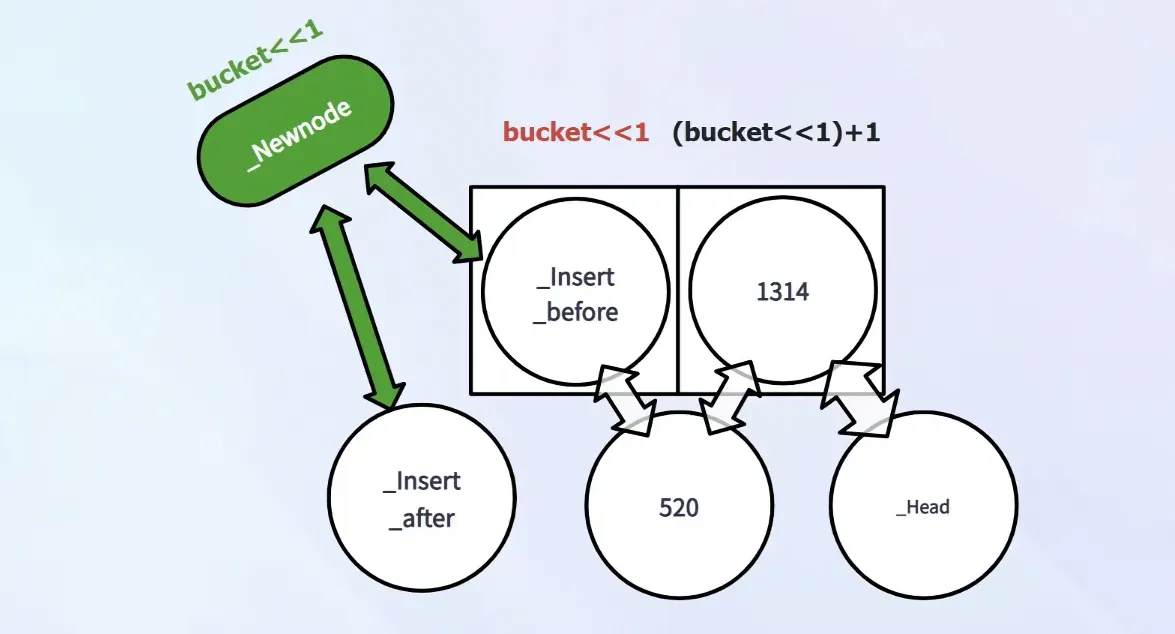
- 元素查找:从双向链表的尾部开始,不断向前遍历。如果键相等就返回,如果一直找不到就会返回全局双向链表的头结点。
- 元素删除:先找到桶ID,然后逆序遍历链表,找到对应结点执行删除操作。
容器特点:
- 线性容器:vector、string、list
- 树形容器:set、multiset、map、multimap
- 线性模拟树:priority_queue
- 散列容器:unordered_set、unordered_map
#include <iostream>
#include <unordered_set>
using namespace std;

int main() {
    unordered_set<int> s;
    return 0;
}
unordered_set 对象创建
#include <iostream>
#include <unordered_set>
using namespace std;

void printUSet(const unordered_set<int>& s) {
    for (unordered_set<int>::const_iterator it = s.begin(); it != s.end(); ++it) {
        cout << *it << " ";
    }
    cout << endl;
}
int main() {
    // 1. 默认构造函数
    unordered_set<int> s1;
    cout << "s1: ";
    printUSet(s1);

    // 2. 初始化列表
    unordered_set<int> s2_1 = { 9, 8, 7, 5, 6 , 1, 2, 3, 4 };
    cout << "s2_1: ";
    printUSet(s2_1);  // s2_1: 1 9 8 7 5 6 2 3 4

    unordered_set<int> s2_2({ 9, 8, 7, 5, 6 , 1, 2, 3, 4 , 6,6,6,6});
    cout << "s2_2: ";
    printUSet(s2_2);  // s2_2: 1 9 8 7 5 6 2 3 4

    // 3. 迭代器
    unordered_set<int> s3(s2_1.begin(), s2_1.end());
    cout << "s3: ";
    printUSet(s3);  // s3: 9 1 8 7 5 6 2 3 4

    // 4. 拷贝构造函数
    unordered_set<int> s4(s2_2);
    cout << "s4: ";
    printUSet(s4);  // s4: 1 9 8 7 5 6 2 3 4

    return 0;
}
unordered_set 赋值操作
#include <iostream>
#include <unordered_set>
using namespace std;

void printUSet(const unordered_set<int>& s) {
    for (unordered_set<int>::const_iterator it = s.begin(); it != s.end(); ++it) {
        cout << *it << " ";
    }
    cout << endl;
}
int main() {
    unordered_set<int> s = { 9, 8, 5, 2, 1, 1 };  // 构造逻辑
    cout << "s: ";
    printUSet(s);  // s: 1 9 8 5 2

    // 1. = set对象
    unordered_set<int> s1;
    s1 = s;
    cout << "s1: ";
    printUSet(s1);  // s1: 9 1 8 5 2

    // 2. 初始化列表
    unordered_set<int> s2;
    s2 = { 3, 4, 7, 6, 7, 8, 9,2,1 };  // 赋值逻辑
    cout << "s2: ";
    printUSet(s2);  // s2: 3 4 7 6 8 1 9 2

    return 0;
}

/*
    unordered_set& operator=(const unordered_set& _Right) {
        _Mybase::operator=(_Right);  // 调用基类的赋值运算符
        return *this;
    }
    unordered_set& operator=(initializer_list<value_type> _Ilist) {  // 赋值列表
        this->clear();
        this->insert(_Ilist);
        return *this;
    }

    using _Mybase        = _Hash<_Uset_traits<_Kty, _Mytraits, _Alloc, false>>;

class _Hash { // hash table -- list with vector of iterators for quick access
    _Hash& operator=(_Hash&& _Right) { // assign by moving _Right
        if (this == _STD addressof(_Right)) {
            return *this;
        }
        .... 从内存中移动数据 ....

*/
unordered_set 大小操作
#include <iostream>
#include <unordered_set>
using namespace std;

void printUSet(const unordered_set<int>& s) {
    for (unordered_set<int>::const_iterator it = s.begin(); it != s.end(); ++it) {
        cout << *it << " ";
    }
    cout << endl;
}
int main() {
    unordered_set<int> s1;
    cout << "s1.empty() = " << s1.empty() << endl;     // 1
    cout << "s1.size() = " << s1.size() << endl;       // 0

    unordered_set<int> s2 = { 1,1,1, 9,9,9,9, 7, 7, 7 };
    cout << "s2.empty() = " << s2.empty() << endl;     // 0
    cout << "s2.size() = " << s2.size() << endl;       // 3

    // unordered_multiset 支持重复元素
    unordered_multiset<int> ms1 = { 1,1,1, 9,9,9,9, 7, 7, 7 };
    cout << "ms1.empty() = " << ms1.empty() << endl;     // 0
    cout << "ms1.size() = " << ms1.size() << endl;       // 10

    return 0;
}
unordered_set 数据插入
#include <iostream>
#include <unordered_set>
using namespace std;

void printUSet(const unordered_set<int>& s) {
    for (unordered_set<int>::const_iterator it = s.begin(); it != s.end(); ++it) {
        cout << *it << " ";
    }
    cout << endl;
}
int main() {
    unordered_set<int> s;

    s.insert(3); printUSet(s); // 3
    s.insert(2); printUSet(s); // 3 2
    s.insert(5); printUSet(s); // 3 2 5
    s.insert(4); printUSet(s); // 3 2 5 4
    s.insert(1); printUSet(s); // 3 2 5 4 1
    s.insert(9); printUSet(s); // 3 2 5 4 9 1
    s.insert(8); printUSet(s); // 3 2 5 4 9 1 8
    s.insert(6); printUSet(s); // 3 2 5 4 9 1 8 6

    vector<int> v = { 1, 9, 9, 7 };
    s.insert(v.begin(), v.end());
    printUSet(s);              // 3 2 5 4 9 1 8 6 7

    return 0;
}
/* 插入源码片段
    conditional_t<_Multi, iterator, pair<iterator, bool>> insert(value_type&& _Val) {
        return emplace(_STD move(_Val));
    }
    conditional_t<_Multi, iterator, pair<iterator, bool>> emplace(_Valtys&&... _Vals) {
        // try to insert value_type(_Vals...)
        using _In_place_key_extractor = typename _Traits::template _In_place_key_extractor<_Valtys...>;
        if constexpr (_Multi) {
            _Check_max_size();
            _List_node_emplace_op2<_Alnode> _Newnode(_List._Getal(), _STD forward<_Valtys>(_Vals)...);
            const auto& _Keyval = _Traits::_Kfn(_Newnode._Ptr->_Myval);
            const auto _Hashval = _Traitsobj(_Keyval);
            if (_Check_rehash_required_1()) {
                _Rehash_for_1();
            }

            const auto _Target = _Find_last(_Keyval, _Hashval);
            return _List._Make_iter(_Insert_new_node_before(_Hashval, _Target._Insert_before, _Newnode._Release()));
        } else if constexpr (_In_place_key_extractor::_Extractable) {
            const auto& _Keyval = _In_place_key_extractor::_Extract(_Vals...);
            const auto _Hashval = _Traitsobj(_Keyval);
            auto _Target        = _Find_last(_Keyval, _Hashval);
            if (_Target._Duplicate) {
                return {_List._Make_iter(_Target._Duplicate), false};
            }

            _Check_max_size();
            // invalidates _Keyval:
            _List_node_emplace_op2<_Alnode> _Newnode(_List._Getal(), _STD forward<_Valtys>(_Vals)...);
            if (_Check_rehash_required_1()) {
                _Rehash_for_1();
                _Target = _Find_last(_Traits::_Kfn(_Newnode._Ptr->_Myval), _Hashval);
            }

            return {
                _List._Make_iter(_Insert_new_node_before(_Hashval, _Target._Insert_before, _Newnode._Release())), true};
        } else {
            _List_node_emplace_op2<_Alnode> _Newnode(_List._Getal(), _STD forward<_Valtys>(_Vals)...);
            const auto& _Keyval = _Traits::_Kfn(_Newnode._Ptr->_Myval); // 拿到键值
            const auto _Hashval = _Traitsobj(_Keyval);                  // 算出哈希值
            auto _Target        = _Find_last(_Keyval, _Hashval);        // 在桶中找到最后一个相同键值的位置
            if (_Target._Duplicate) {  // 如果找到了重复的键值,直接返回
                return {_List._Make_iter(_Target._Duplicate), false};
            }

            _Check_max_size();
            if (_Check_rehash_required_1()) {
                _Rehash_for_1();
                _Target = _Find_last(_Traits::_Kfn(_Newnode._Ptr->_Myval), _Hashval);
            }

            return { // 没有重复键值,插入新节点
                _List._Make_iter(_Insert_new_node_before(_Hashval, _Target._Insert_before, _Newnode._Release())), true};
        }
    }

    _Nodeptr _Insert_new_node_before(
       // 双向链表插入操作
        const size_t _Hashval, const _Nodeptr _Insert_before, const _Nodeptr _Newnode) noexcept {
        const _Nodeptr _Insert_after = _Insert_before->_Prev;
        ++_List._Mypair._Myval2._Mysize;
        _Construct_in_place(_Newnode->_Next, _Insert_before);
        _Construct_in_place(_Newnode->_Prev, _Insert_after);
        _Insert_after->_Next  = _Newnode;
        _Insert_before->_Prev = _Newnode;

        // 处理插入时,两个桶的边界
        // ==========================================
        const auto _Head                = _List._Mypair._Myval2._Myhead;
        const auto _Bucket_array        = _Vec._Mypair._Myval2._Myfirst;
        const size_type _Bucket         = _Hashval & _Mask;
        _Unchecked_iterator& _Bucket_lo = _Bucket_array[_Bucket << 1];
        _Unchecked_iterator& _Bucket_hi = _Bucket_array[(_Bucket << 1) + 1];
        if (_Bucket_lo._Ptr == _Head) {
            // bucket is empty, set both
            _Bucket_lo._Ptr = _Newnode;
            _Bucket_hi._Ptr = _Newnode;
        } else if (_Bucket_lo._Ptr == _Insert_before) {
            // new node is the lowest element in the bucket
            _Bucket_lo._Ptr = _Newnode;
        } else if (_Bucket_hi._Ptr == _Insert_after) {
            // new node is the highest element in the bucket
            _Bucket_hi._Ptr = _Newnode;
        }
        // ==========================================

#ifdef _ENABLE_STL_INTERNAL_CHECK
        _Stl_internal_check_container_invariants();
#endif // _ENABLE_STL_INTERNAL_CHECK
        return _Newnode;
    }
*/
unordered_set 数据查找
#include <iostream>
#include <unordered_set>
using namespace std;

void printUSet(const unordered_set<int>& s) {
    for (unordered_set<int>::const_iterator it = s.begin(); it != s.end(); ++it) {
        cout << *it << " ";
    }
    cout << endl;
}
int main() {
    unordered_set<int> s = { 1, 2, 3,4,5 };
    unordered_set<int>::iterator it = s.find(3);

    if (it != s.end()) { // find成功
        cout << "find :" << *it << endl;
    }
    it = s.find(10);
    if (it == s.end()) { // find失败
        cout << "can't find: 10" << endl;
    }


    return 0;
}
/* 源码片段
    _NODISCARD iterator find(const key_type& _Keyval) {
        return _List._Make_iter(_Find(_Keyval, _Traitsobj(_Keyval)));
    }

    _Nodeptr _Find(const _Keyty& _Keyval, const size_t _Hashval) const {
        if constexpr (_Traits::_Multi) {
            return _Find_first(_Keyval, _Hashval);
        } else { // 如果不是multiset,则使用_Find_last
            // use _Find_last for unique containers to avoid increase in code size of instantiating _Find_first
            auto _Target = _Find_last(_Keyval, _Hashval)._Duplicate;
            if (_Target) {
                return _Target;
            }

            return _List._Mypair._Myval2._Myhead; // 没找到,返回双向链表的头结点
        }
    }

    _NODISCARD _Hash_find_last_result<_Nodeptr> _Find_last(const _Keyty& _Keyval, const size_t _Hashval) const {
        // find the insertion point for _Keyval and whether an element identical to _Keyval is already in the container
        const size_type _Bucket = _Hashval & _Mask;  // 哈希取模后,得到桶ID
        _Nodeptr _Where         = _Vec._Mypair._Myval2._Myfirst[(_Bucket << 1) + 1]._Ptr; // 找到桶的尾部
        const _Nodeptr _End     = _List._Mypair._Myval2._Myhead;
        if (_Where == _End) {  // 如果桶的尾部和全局双向链表的头结点相同,说明桶是空的,没找到
            return {_End, _Nodeptr{}};  // 返回end
        }

        const _Nodeptr _Bucket_lo = _Vec._Mypair._Myval2._Myfirst[_Bucket << 1]._Ptr;
        for (;;) { // 从桶的尾部开始向前搜索
            // Search backwards to maintain sorted [_Bucket_lo, _Bucket_hi] when !_Standard
            if (!_Traitsobj(_Keyval, _Traits::_Kfn(_Where->_Myval))) {
                if constexpr (!_Traits::_Standard) {
                    if (_Traitsobj(_Traits::_Kfn(_Where->_Myval), _Keyval)) {
                        return {_Where->_Next, _Nodeptr{}};
                    }
                }

                return {_Where->_Next, _Where};
            }

            if (_Where == _Bucket_lo) {
                return {_Where, _Nodeptr{}};
            }

            _Where = _Where->_Prev;
        }
    }
*/
unordered_set 数据删除
#include <iostream>
#include <unordered_set>
using namespace std;

void printUSet(const unordered_set<int>& s) {
    for (unordered_set<int>::const_iterator it = s.begin(); it != s.end(); ++it) {
        cout << *it << " ";
    }
    cout << endl;
}
int main() {
    unordered_set<int> s = { 1, 2, 3,4,5 };
    s.erase(3);
    printUSet(s);  // 1 2 4 5

    unordered_set<int>::iterator it = s.find(4);
    if (it != s.end()) {
        s.erase(it);
    }
    printUSet(s);  // 1 2 5

    s = { 16, 12,3,4,5,6,7,8,9,10,11,12,13,14,15 };
    unordered_set<int>::iterator itl = s.find(12);
    unordered_set<int>::iterator itr = s.find(14);
    s.erase(itl, itr);  // 如果是个范围删除,删除的是前闭后开区间,不建议使用,因为unordered_set是无序的,范围删除意义不大
    printUSet(s); // 8 16 4 14 15

    s.clear(); // 清空

    return 0;
}
/* 源码片段
    size_type erase(const key_type& _Keyval) noexcept(noexcept(_Erase(_Keyval))) {
    return _Erase(_Keyval);
}

    size_type _Erase(const _Keytype& _Keyval) noexcept(_Noexcept_heterogeneous_erasure<_Keytype>()){
    const size_t _Hashval = _Traitsobj(_Keyval);
    if constexpr (_Multi) {
        const auto _Where = _Equal_range(_Keyval, _Hashval);
        _Unchecked_erase(_Where._First._Ptr, _Where._Last._Ptr);
        return _Where._Distance;
    }
    else {
        const auto _Target = _Find_last(_Keyval, _Hashval)._Duplicate;
        if (_Target) { // 有这个结点执行删除
            _Erase_bucket(_Target, _Hashval & _Mask); // 处理bucket的边界
            _List._Unchecked_erase(_Target);          // 删除操作
            return 1;
        }

        return 0;
    }
}

    void _Erase_bucket(_Nodeptr _Plist, size_type _Bucket) noexcept {
        // remove the node _Plist from its bucket
        _Nodeptr& _Bucket_lo = _Vec._Mypair._Myval2._Myfirst[_Bucket << 1]._Ptr;
        _Nodeptr& _Bucket_hi = _Vec._Mypair._Myval2._Myfirst[(_Bucket << 1) + 1]._Ptr;
        if (_Bucket_hi == _Plist) {
            if (_Bucket_lo == _Plist) { // make bucket empty 如果头尾节点都删完了,头尾变成全局双向链表的虚拟头节点
                const auto _End = _List._Mypair._Myval2._Myhead;

                _Bucket_lo = _End;
                _Bucket_hi = _End;
            } else {
                _Bucket_hi = _Plist->_Prev; // move end back one element
            }
        } else if (_Bucket_lo == _Plist) {
            _Bucket_lo = _Plist->_Next; // move beginning up one element
        }
    }

class list { // bidirectional linked list
    _Nodeptr _Unchecked_erase(const _Nodeptr _Pnode) noexcept { // erase element at _Pnode
        const auto _Result = _Pnode->_Next;
        _Mypair._Myval2._Orphan_ptr2(_Pnode);
        --_Mypair._Myval2._Mysize;
        _Pnode->_Prev->_Next = _Result; // _Pnode是要删除的节点。把它的前驱节点的_next指向它的后继节点
        _Result->_Prev       = _Pnode->_Prev; // 把它的后继节点的_prev指向它的前驱节点
        _Node::_Freenode(_Getal(), _Pnode);
        return _Result;
    }
*/
unordered_set 数据统计
#include <iostream>
#include <unordered_set>
using namespace std;

void printUSet(const unordered_set<int>& s) {
    for (unordered_set<int>::const_iterator it = s.begin(); it != s.end(); ++it) {
        cout << *it << " ";
    }
    cout << endl;
}

void printUMSet(const unordered_multiset<int>& s) {
    for (unordered_multiset<int>::const_iterator it = s.begin(); it != s.end(); ++it) {
        cout << *it << " ";
    }
    cout << endl;
}

int main() {
    unordered_set<int> s = { 1, 2, 3,4,5 };
    for (int i = 0; i < 8; i += 2) {
        cout << "元素:" << i << "的出现次数是 " << s.count(i) << endl;
    }
    printUSet(s); // 1 2 3 4 5

    // 为什么引入count,而不是has(i)?  尽量保持一致

    unordered_multiset<int> ms = { 1,1,1,1,2,2,2,2,2, 3,3,3,3,3,4,4,4,7,7,7,7 };
    for (int i = 0; i < 8; i += 2) {
        cout << "元素:" << i << "的出现次数是 " << ms.count(i) << endl;
    }
    printUMSet(ms); // 1 2 3 4 5
    return 0;
}
/* 执行结果
元素:0的出现次数是 0
元素:2的出现次数是 1
元素:4的出现次数是 1
元素:6的出现次数是 0
1 2 3 4 5
元素:0的出现次数是 0
元素:2的出现次数是 5
元素:4的出现次数是 3
元素:6的出现次数是 0
1 1 1 1 2 2 2 2 2 3 3 3 3 3 4 4 4 7 7 7 7
*/

/* 源码片段
    _NODISCARD size_type count(const key_type& _Keyval) const {
        const size_t _Hashval = _Traitsobj(_Keyval);
        if constexpr (_Multi) {
            return _Equal_range(_Keyval, _Hashval)._Distance;
        } else {
            return static_cast<bool>(_Find_last(_Keyval, _Hashval)._Duplicate);
        }
    }
*/
练习
相交链表
https://leetcode.cn/problems/intersection-of-two-linked-lists/
给你两个单链表的头节点 headA 和 headB ,请你找出并返回两个单链表相交的起始节点。如果两个链表不存在相交节点,返回 null 。

图示两个链表在节点 c1 开始相交:


题目数据 保证 整个链式结构中不存在环。

注意,函数返回结果后,链表必须 保持其原始结构 。

自定义评测:
评测系统 的输入如下(你设计的程序 不适用 此输入):
intersectVal - 相交的起始节点的值。如果不存在相交节点,这一值为 0
listA - 第一个链表
listB - 第二个链表
skipA - 在 listA 中(从头节点开始)跳到交叉节点的节点数
skipB - 在 listB 中(从头节点开始)跳到交叉节点的节点数
评测系统将根据这些输入创建链式数据结构,并将两个头节点 headA 和 headB 传递给你的程序。
如果程序能够正确返回相交节点,那么你的解决方案将被 视作正确答案 。
/**
 * Definition for singly-linked list.
 * struct ListNode {
 *     int val;
 *     ListNode *next;
 *     ListNode(int x) : val(x), next(NULL) {}
 * };
 */
class Solution {
public:
    ListNode *getIntersectionNode(ListNode *headA, ListNode *headB) {
        unordered_set<ListNode*> us;
        while(headA) {
            us.insert(headA);
            headA = headA->next;
        }
        while(headB) {
            if(us.find(headB) != us.end()) {
                return headB;
            }
            headB = headB->next;
        }
        return NULL;
    }
};
重复的DNA序列
https://leetcode.cn/problems/repeated-dna-sequences/
DNA序列 由一系列核苷酸组成,缩写为 'A', 'C', 'G' 和 'T'.。

例如,"ACGAATTCCG" 是一个 DNA序列 。
在研究 DNA 时,识别 DNA 中的重复序列非常有用。

给定一个表示 DNA序列 的字符串 s ,返回所有在 DNA 分子中出现不止一次的 长度为 10 的序列(子字符串)。
你可以按 任意顺序 返回答案。

示例 1:
输入:s = "AAAAACCCCCAAAAACCCCCCAAAAAGGGTTT"
输出:["AAAAACCCCC","CCCCCAAAAA"]

示例 2:
输入:s = "AAAAAAAAAAAAA"
输出:["AAAAAAAAAA"]

提示:
0 <= s.length <= 105
s[i]=='A'、'C'、'G' or 'T'
class Solution {
public:
    vector<string> findRepeatedDnaSequences(string s) {
        unordered_multiset<string> ums;
        vector<string> ans;
        for(int i = 0; i < s.size(); ++i) {
            string sub = s.substr(i, 10); // 从指定位置出发找到10个字符
            ums.insert(sub);
            if(ums.count(sub) == 2 ) {
                ans.push_back(sub);
            }
        }
        return ans;
    }
};
unordered_map
unordered_map 基础概念
功能和map类似。相比map的有序映射,它的底层数据存储时是无序的,并且底层数据和unordered_set一样是哈希表。
因为是无序,它又是一种键值对,所以叫它无序映射。
set和map区别
- set的元素是一个数据,map的元素则是两个数据(一个pair)
unordered_set和unordered_map区别和set和map区别一样。
unordered_set<type>

unordered_map<type1, type2>
容器特点:
- 线性容器:vector、string、list
- 树形容器:set、multiset、map、multimap
- 线性模拟树:priority_queue
- 散列容器:unordered_set、unordered_map
#include <iostream>
#include <unordered_map>
using namespace std;

int main() {
    unordered_map<int, int> m;

    return 0;
}
/* 源码片段:
// 与unordered_set一样继承自_Hash
// 通过_Umap_traits来区分是map还是set
class unordered_map : public _Hash<_Umap_traits<_Kty, _Ty, _Uhash_compare<_Kty, _Hasher, _Keyeq>, _Alloc, false>> {


class _Umap_traits : public _Tr { // traits required to make _Hash behave like a map
public:
    using key_type            = _Kty;
    using value_type          = pair<const _Kty, _Ty>;
    using _Mutable_value_type = pair<_Kty, _Ty>;
    using key_compare         = _Tr;
    using allocator_type      = _Alloc;

    // 这里有_In_place_key_extract_map
    using _In_place_key_extractor = _In_place_key_extract_map<_Kty, _Args...>;

using _In_place_key_extract_map = _In_place_key_extract_map_impl<_Remove_const_ref_t<_Valtys>...>;

struct _In_place_key_extract_map_impl<_Key, _Key, _Second> {
    // if we would call the pair(key, value) constructor family, we can use the first parameter as the key
    static constexpr bool _Extractable = true;
    static const _Key& _Extract(const _Key& _Val, const _Second&) noexcept { // 在插入hash时要有个key作为hash表索引
        return _Val;
    }
};

struct _In_place_key_extract_map_impl<_Key, pair<_First, _Second>> {
    // if we would call the pair(pair<other, other>) constructor family, we can use the pair.first member as the key
    static constexpr bool _Extractable = is_same_v<_Key, _Remove_const_ref_t<_First>>;
    static const _Key& _Extract(const pair<_First, _Second>& _Val) noexcept { // 在插入hash时要有个key作为hash表索引
        return _Val.first;
    }
};
*/
unordered_map 对象创建
#include <iostream>
#include <unordered_map>
using namespace std;

void printUMap(const unordered_map<int, int>& m) {
    for (unordered_map<int, int>::const_iterator it = m.begin(); it != m.end(); it++) {
        cout << "key = " << it->first << " " << "value = " << it->second << endl;
    }
    cout << "-----------------" << endl;
}
int main() {
    // 1. 默认构造函数
    unordered_map<int, int> m1;
    cout << "m1: " << endl;
    printUMap(m1);

    unordered_map<int, int> m2_1 = {
        pair<int, int>(1, 10),
        pair<int, int>(4, 24),
        pair<int, int>(3, 43),
        pair<int, int>(2, 15),
    };
    cout << "m2_1: " << endl;
    printUMap(m2_1);

    unordered_map<int, int> m2_2({
    pair<int, int>(1, 10),
    pair<int, int>(4, 24),
    pair<int, int>(3, 43),
    pair<int, int>(2, 15),
    });
    cout << "m2_2: " << endl;
    printUMap(m2_2);

    // 3. 迭代器
    unordered_map<int, int> m3(m2_1.begin(), m2_1.end());
    cout << "m3: " << endl;
    printUMap(m3);

    // 4. 拷贝构造函数
    unordered_map<int, int> m4(m2_2);
    cout << "m4: " << endl;
    printUMap(m4);

    return 0;
}
/* 执行结果:
m1:
-----------------
m2_1:
key = 1 value = 10
key = 4 value = 24
key = 3 value = 43
key = 2 value = 15
-----------------
m2_2:
key = 1 value = 10
key = 4 value = 24
key = 3 value = 43
key = 2 value = 15
-----------------
m3:
key = 1 value = 10
key = 4 value = 24
key = 3 value = 43
key = 2 value = 15
-----------------
m4:
key = 1 value = 10
key = 4 value = 24
key = 3 value = 43
key = 2 value = 15
-----------------
*/
unordered_map 赋值操作
#include <iostream>
#include <unordered_map>
using namespace std;

void printUMap(const unordered_map<int, int>& m) {
    for (unordered_map<int, int>::const_iterator it = m.begin(); it != m.end(); it++) {
        cout << "key = " << it->first << " " << "value = " << it->second << endl;
    }
    cout << "-----------------" << endl;
}
int main() {
    unordered_map<int, int> m = {
        pair<int, int>(1, 10),
        pair<int, int>(2, 30),
        pair<int, int>(4, 30),
        pair<int, int>(3, 110),
    };
    cout << "m: " << endl;
    printUMap(m);

    // 1. = 对象
    unordered_map<int, int> m1;
    m1 = m;
    cout << "m1: " << endl;
    printUMap(m1);

    // 2. 初始化列表
    unordered_map<int, int> m2;
    m2 = {
        pair<int, int>(5,10), pair<int, int>(2, 10), pair<int, int>(4,31), pair<int, int>(3,610)
    };
    cout << "m2: " << endl;
    printUMap(m2);
    return 0;
}
/* 执行结果:
m:
key = 1 value = 10
key = 2 value = 30
key = 4 value = 30
key = 3 value = 110
-----------------
m1:
key = 1 value = 10
key = 2 value = 30
key = 4 value = 30
key = 3 value = 110
-----------------
m2:
key = 5 value = 10
key = 2 value = 10
key = 4 value = 31
key = 3 value = 610
-----------------
*/
unordered_map 大小操作
#include <iostream>
#include <unordered_map>
using namespace std;

int main() {
    unordered_map<int, int> m;
    cout << "m.empty() = " << m.empty() << endl;  // 1
    cout << "m.size() = " << m.size() << endl;    // 0

    m = { pair<int, int>(52,0), pair<int, int>(13,14) };
    cout << "m.empty() = " << m.empty() << endl;  // 0
    cout << "m.size() = " << m.size() << endl;    // 2

    return 0;
}
unordered_map 数据插入
#include <iostream>
#include <unordered_map>
using namespace std;

void printUMap(const unordered_map<int, int>& m) {
    for (unordered_map<int, int>::const_iterator it = m.begin(); it != m.end(); it++) {
        cout << "key = " << it->first << " " << "value = " << it->second << endl;
    }
    cout << "-----------------" << endl;
}

int main() {
    unordered_map<int, int> m;

    // 1
    m.insert(pair<int, int>(1, 10));
    printUMap(m);

    // 2
    m.insert(make_pair(3, 20));
    printUMap(m);

    // 3
    m.insert(unordered_map<int, int>::value_type(4, 7));  // 函数重载
    printUMap(m);

    // 4
    m[88] = 6; // 运算符重载
    printUMap(m);

    // 区别
    // 5
    pair<unordered_map<int, int>::iterator, bool> ret = m.insert(pair<int, int>(4, 10));
    cout << "insert(4, 10) = " << ret.second << endl;  // insert(4, 10) = 0  键已经有了,就会插入失败
    printUMap(m);

    // 6
    m[3] = 66; // 键存在,则修改该对应的值
    printUMap(m);

    // 是否是中括号更好?
    // 7
    m[0];  // 访问0时,如果不存在会直接赋值 key = 0 value = 0
    printUMap(m);

    return 0;
}
/* 源码片段:
    pair<iterator, bool> insert(_Valty&& _Val) {
        return this->emplace(_STD forward<_Valty>(_Val));
    }
*/

/* 执行结果:
key = 1 value = 10
-----------------
key = 1 value = 10
key = 3 value = 20
-----------------
key = 1 value = 10
key = 3 value = 20
key = 4 value = 7
-----------------
key = 1 value = 10
key = 3 value = 20
key = 4 value = 7
key = 88 value = 6
-----------------
insert(4, 10) = 0
key = 1 value = 10
key = 3 value = 20
key = 4 value = 7
key = 88 value = 6
-----------------
key = 1 value = 10
key = 3 value = 66
key = 4 value = 7
key = 88 value = 6
-----------------
key = 1 value = 10
key = 3 value = 66
key = 4 value = 7
key = 0 value = 0
key = 88 value = 6
-----------------
*/
unordered_map 数据查找
#include <iostream>
#include <unordered_map>
using namespace std;

int main() {
    unordered_map<int, int> m;
    m[1] = 1;
    m[2] = 3;
    m[3] = 6;
    m[666] = 886;

    for (int i = 0; i <= 4; ++i) {
        unordered_map<int, int>::iterator it = m.find(i);
        if (it != m.end()) {
            cout << "找到键值对:(" << it->first << "," << it->second << ")" << endl;
        }
        else {
            cout << "未找到键" << i << endl;
        }
    }
    //cout << m[3] << endl; // 这种方式不能做为查找键的依据
    //cout << m[5] << endl; // 不存在时会赋值

    return 0;
}
unordered_map 数据删除
#include <iostream>
#include <unordered_map>
using namespace std;

void printUMap(const unordered_map<int, int>& m) {
    for (unordered_map<int, int>::const_iterator it = m.begin(); it != m.end(); it++) {
        cout << "key = " << it->first << " " << "value = " << it->second << endl;
    }
    cout << "-----------------" << endl;
}

int main() {
    unordered_map<int, int> m;
    m[1] = 1;
    m[2] = 5;
    m[4] = 7;
    m[9] = 8;
    printUMap(m);

    // 1
    m.erase(2); // 删除2这个键
    printUMap(m);

    // 2
    m.erase(m.begin());
    printUMap(m);

    // 3
    m.erase(m.begin(), m.end());
    printUMap(m);

    // 4
    m[5] = 3;
    m[7] = 9;
    printUMap(m);
    m.clear(); // 清空
    printUMap(m);

    return 0;
}


/* 执行结果:
key = 9 value = 8
key = 1 value = 1
key = 2 value = 5
key = 4 value = 7
-----------------
key = 9 value = 8
key = 1 value = 1
key = 4 value = 7
-----------------
key = 1 value = 1
key = 4 value = 7
-----------------
-----------------
key = 5 value = 3
key = 7 value = 9
-----------------
-----------------
*/
unordered_map 数据修改
#include <iostream>
#include <unordered_map>
using namespace std;

void printUMap(const unordered_map<int, int>& m) {
    for (unordered_map<int, int>::const_iterator it = m.begin(); it != m.end(); it++) {
        cout << "key = " << it->first << " " << "value = " << it->second << endl;
    }
    cout << "-----------------" << endl;
}

int main() {
    unordered_map<int, int> m;
    m.insert(make_pair(1, 20));
    m.insert(make_pair(2, 333));
    m.insert(make_pair(3, 666));

    m[3] = 888;
    printUMap(m);

    m[2]++;
    printUMap(m);

    m[1] -= 21; // 复合运算符
    printUMap(m);

    return 0;
}


/* 执行结果:
key = 1 value = 20
key = 2 value = 333
key = 3 value = 888
-----------------
key = 1 value = 20
key = 2 value = 334
key = 3 value = 888
-----------------
key = 1 value = -1
key = 2 value = 334
key = 3 value = 888
-----------------
*/
unordered_map 数据统计
#include <iostream>
#include <unordered_map>
using namespace std;

void printUMap(const unordered_map<int, int>& m) {
    for (unordered_map<int, int>::const_iterator it = m.begin(); it != m.end(); it++) {
        cout << "key = " << it->first << " " << "value = " << it->second << endl;
    }
    cout << "-----------------" << endl;
}

int main() {
    unordered_map<int, int> m = {
        pair<int, int>(1, 4),
        pair<int, int>(3, 33),
        pair<int, int>(2, 88),
        pair<int, int>(2, 77),
        pair<int, int>(5, 666),
    };
    for (int i = -1; i < 3; ++i) {
        cout << i << "的出现次数是" << m.count(i) << endl;
    }
    cout << "--------" << endl;

    unordered_multimap<int, int> mm = {
    pair<int, int>(1, 4),
    pair<int, int>(1, 4),
    pair<int, int>(1, 4),
    pair<int, int>(3, 33),
    pair<int, int>(3, 33),
    pair<int, int>(2, 88),
    pair<int, int>(2, 77),
    pair<int, int>(5, 666),
    };
    for (int i = -1; i < 3; ++i) {
        cout << i << "的出现次数是" << mm.count(i) << endl;
    }


    return 0;
}

/* 执行结果:
-1的出现次数是0
0的出现次数是0
1的出现次数是1
2的出现次数是1
--------
-1的出现次数是0
0的出现次数是0
1的出现次数是3
2的出现次数是2
*/
练习
四数相加 II
https://leetcode.cn/problems/4sum-ii/
给你四个整数数组 nums1、nums2、nums3 和 nums4 ,数组长度都是 n ,请你计算有多少个元组 (i, j, k, l) 能满足:

0 <= i, j, k, l < n
nums1[i] + nums2[j] + nums3[k] + nums4[l] == 0

示例 1:
输入:nums1 = [1,2], nums2 = [-2,-1], nums3 = [-1,2], nums4 = [0,2]
输出:2
解释:
两个元组如下:
1. (0, 0, 0, 1) -> nums1[0] + nums2[0] + nums3[0] + nums4[1] = 1 + (-2) + (-1) + 2 = 0
2. (1, 1, 0, 0) -> nums1[1] + nums2[1] + nums3[0] + nums4[0] = 2 + (-1) + (-1) + 0 = 0

示例 2:
输入:nums1 = [0], nums2 = [0], nums3 = [0], nums4 = [0]
输出:1

提示:
n == nums1.length
n == nums2.length
n == nums3.length
n == nums4.length
1 <= n <= 200
-228 <= nums1[i], nums2[i], nums3[i], nums4[i] <= 228
class Solution {
public:
    int fourSumCount(vector<int>& nums1, vector<int>& nums2, vector<int>& nums3, vector<int>& nums4) {
        unordered_map<int, int> hash;
        for(int i = 0; i < nums1.size(); ++i) {
            for(int j = 0; j < nums2.size(); ++j) {
               hash[ -(nums1[i] + nums2[j]) ]++;
            }
        }
        int ans = 0;
        for(int k = 0; k < nums3.size(); ++k) {
            for(int l = 0; l < nums4.size(); ++l) {
               ans += hash[ nums3[k] + nums4[l] ];
            }
        }
        return ans;
    }
};

// nums1[i] + nums2[j] + nums3[k] + nums4[l] == 0
//  nums3[k] + nums4[l] == -(nums1[i] + nums2[j])
和为 K 的子数组
https://leetcode.cn/problems/subarray-sum-equals-k/
给你一个整数数组 nums 和一个整数 k ,请你统计并返回 该数组中和为 k 的子数组的个数 。

子数组是数组中元素的连续非空序列。

示例 1:
输入:nums = [1,1,1], k = 2
输出:2

示例 2:
输入:nums = [1,2,3], k = 3
输出:2

提示:
1 <= nums.length <= 2 * 104
-1000 <= nums[i] <= 1000
-107 <= k <= 107
class Solution {
public:
    int subarraySum(vector<int>& nums, int k) {
        unordered_map<int, int> cnt; // 键是pre[i]的值,值是pre[i]出现的次数
        int ans = 0;
        int pre = 0;
        cnt[pre]++;
        for(int i = 0; i < nums.size(); ++i) {
            pre = pre + nums[i]; // 等于 pre[i] = pre[i-1] + nums[i];
            ans += cnt[pre - k];
            cnt[pre]++;
        }
        return ans;
    }
};

/*
[j ... i] 子数组和是k,         sum(j...i) = k
pre[i] 代表了[0...i]中元素的和  pre[i] = sum(0...i)
于是
1. pre[i] - pre[j-1] == k
2. pre[j-1] = pre[i] - k   (0 <= j <= i)
所以以i为结尾的和为k连续数组的个数,就是计算出pre[i] - k的值,然后到下标0到i中找所以满足的前缀和的个数。
*/